
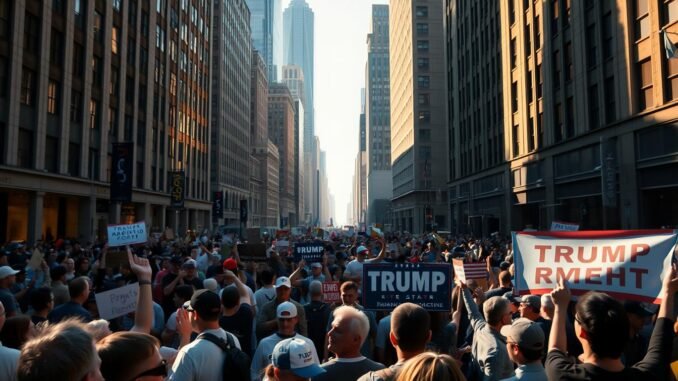

Over 1 million ballots will soon decide New York’s future. But before that, Donald Trump made a bold call to Jewish voters. His words were like a flare in a crowded field, where every statement can sway a campaign.
On Truth Social, Trump urged New Yorkers to support Andrew Cuomo over Zohran Mamdani. He called Mamdani a “radical socialist who hates Israel.” Trump warned of federal funding cuts and a city collapse if Mamdani won. His post heightened tensions around voting, political parties, and city democracy.
Mamdani, a 34-year-old progressive Democrat, denied being antisemitic. He said his focus is on Israeli government policies, not Jewish people. This clash offers a clear choice for voters and has set the stage for a dramatic campaign, with national and global implications.
Overview of Trump’s intervention and the New York mayoral context
Donald Trump entered New York City politics as the race got tighter. The national media watched closely. His move came as campaigns tested their messages and tracked late polls.
Rival political parties saw it as a chance to show their vision for the city. For those in new york montreal circles, the election felt very personal. This year, the election excitement was high, with many people voting.
Trump’s Truth Social remarks and charges of antisemitism
On Truth Social, Trump accused Zohran Mamdani of antisemitism. He urged Jewish voters to reject him. He also warned of cuts to federal aid and said the city could fail if Mamdani won.
The posts came as polls were changing daily. This added to the tension in the electoral process. The ballot box became a focal point of a cultural clash.
How this shapes a fiercely contested mayoral race
Trump’s intervention changed the race, forcing rivals to respond. It tested alliances across political parties. Campaigns adjusted their strategies, including ad buys and debate lines.
Voters had to consider policy and personality. With more people voting, the threat of funding cuts became a key issue. This was discussed in neighbourhood forums and last-minute efforts to get people to vote.
Why the moment resonates with Canadian readers following US politics
Canadians from new york montreal networks saw debates on antisemitism and Islamophobia. They also saw discussions on the cost of living. Transit, child care, and rent policy were also linked.
Concerns about federal influence on local budgets were shared. The story showed how fast narratives can spread. They shape polls, campaign tone, and trust in government far beyond one city’s ballot box.
Key quotes and claims that ignited the controversy
The week’s words changed the election mood and made the campaign more intense. Candidates had to defend themselves quickly. The media played the most critical moments over and over.
“Any Jewish person that votes for Zohran Mamdani … is a stupid person”
Donald Trump’s words sparked outrage and filled the news. His statement was made at a critical time, making his name a big deal. Discussions about faith, identity, and safety spread fast.
By morning, the clip was everywhere on TV. It influenced polls and conversations. The election now focused on making judgements, trust, and who decides what’s okay to say.
Threats to cut federal funding and talk of a city “collapse”
Trump said New York would fail and might lose federal money if it made the wrong choice. This brought Ottawa and Washington into the mix. It changed the campaign to focus on national influence.
Now, money matters a lot. People think about transit, housing, and safety versus the risk of losing support. Candidates adjusted their messages to fit the mood.
Escalatory rhetoric about “taking over” New York
Talking about taking over the city added more heat. It made the election seem like a direct fight for power. Experts said this could sway undecided voters and turn the election into a test of control.
As the campaign ends, each candidate is careful with their words. They know one statement can change everything. The stakes feel higher, and every word is important.
Mamdani’s response and positioning with progressive allies
Zohran Mamdani stood up for democracy in New York. He said the campaign should talk about real costs. He wanted candidates to be clear on housing, transit, and care.
Denials of antisemitism and focus on Israeli government policy
Mamdani denied being antisemitic. He said his criticism was about Israeli government actions, not Jewish people. He believed this was a human rights stand, fitting for a free democracy.
Endorsements from Bernie Sanders and Alexandria Ocasio-Cortez
Support from Bernie Sanders and Alexandria Ocasio-Cortez showed trust in Mamdani’s vision. Their backing helped him with union members, renters, and students. It also made other candidates explain their funding plans.
Core planks: rent freeze, free child care, and fare-free buses
Mamdani’s plan aimed to make life more affordable. He wanted a rent freeze, free child care, and fare-free buses. He also pushed for a higher minimum wage and taxes on the wealthy. His campaign showed how these steps could help more people, letting voters decide after the election.
| Policy | Who Benefits | Funding Approach | Democracy Impact |
|---|---|---|---|
| Rent freeze | Rent-stabilized tenants, low‑income families | Stronger rent board rules; targeted revenue from high earners | Stabilizes housing, expands voice of renters in city decisions |
| Free child care | Working parents, caregivers, early‑education staff | Progressive taxation; reallocation of city funds | Improves access to work and school participation |
| Fare-free buses | Transit riders, shift workers, students | Dedicated transit levies; intergovernmental agreements | Boosts turnout at civic events and eases mobility barriers |
| $30/hour minimum wage | Low‑wage workers across sectors | Phased implementation with small‑business supports | Raises bargaining power and civic engagement |
Where Andrew Cuomo and Curtis Sliwa fit in the race
Andrew Cuomo entered the race as a moderate choice, promising stability and competence. He got a $1.5 million boost from Michael Bloomberg’s PAC. This move aimed to attract swing voters and independents who follow polls closely.
His campaign contrasted with the movement energy of other candidates. It was about choosing between technical skills and fresh ideas in city government.
Donald Trump’s endorsement of Cuomo shook things up. It attracted disaffected Republicans and tested party alliances. The timing suggested a strategy to win over centre-right voters without losing progressive support.
Curtis Sliwa, the Republican candidate, focused on crime and living costs in his campaign. He pushed Mamdani from the right, calling for a law-and-order shift in city government. Sliwa aimed to secure conservative votes and sway moderates away from the left.
Cuomo’s team highlighted his managerial skills. Sliwa’s campaign focused on his street-level toughness. Polls showed a close race for second place, with both candidates seeking voters who want change but stability.
For Canadians in Toronto, Vancouver, and Montreal, the debate mirrored local issues like affordability, transit, and safety. It showed how political parties try to form winning coalitions in big cities.
| Figure | Positioning | Key Backing | Voter Target | Signature Appeal | Campaign Effect on Polls |
|---|---|---|---|---|---|
| Andrew Cuomo | Moderate alternative | Michael Bloomberg’s PAC; late Trump endorsement | Moderates, independents, disaffected Republicans | Management experience, steady government | Lift among centre-right and swing voters |
| Curtis Sliwa | Right-leaning challenger | Republican base networks | Conservatives, outer-borough homeowners | Public safety focus, street-level presence | Consolidated right flank, pressured rivals |
| Zohran Mamdani | Progressive frontrunner | Grassroots donors; movement groups | Young voters, renters, transit riders | Affordability agenda; bold city services | Held lead despite late-campaign shifts |
In the campaign’s final stretch, Cuomo and Sliwa defined the centre and right. Mamdani anchored the left. Their interactions influenced how polls moved and how parties framed the election’s importance.
election
New York’s citywide vote was filled with energy. People waited before dawn, and the polling stations were busy but calm. Reporters saw a lot of voting in Queens, Manhattan, and Brooklyn. People were talking about rent, transit, and wanting a more peaceful city.
Turnout, polling station activity, and the electoral process
This was the highest turnout for a non-presidential election in decades. Early voting and lively neighbourhoods helped. Zohran Mamdani, Andrew Cuomo, and Curtis Sliwa voted early in Queens and Manhattan.
There were long lines, but they moved quickly. The electoral process worked well, thanks to volunteers. They helped newcomers understand how to use the ballot box.
From ranked-choice primaries to a simple plurality general vote
The spring primaries used ranked-choice voting. This let voters list their preferences, shaping the final candidates.
The general election was simpler. Whoever got the most votes won. This straightforward approach ended a complex electoral process.
Ballot box energy and the electorate’s motivations
At the ballot box, people talked about needing rent relief, free buses, and child care. They also wanted less arguing and more focus on everyday life.
DSA watch parties showed the same excitement. The electorate was eager for local solutions and a better city. This energy moved from the polling station to community events, keeping voting in everyone’s thoughts.
How Trump’s endorsement dynamics influenced candidates and voters
Donald Trump’s entry changed the election’s pace. His posts affected every campaign, making parties and donors adjust quickly. In a city race, national issues met local ones, and polls changed fast.
Backing Cuomo while attacking Mamdani
Trump praised Andrew Cuomo and criticized Zohran Mamdani. This split message made moderates stick together and drew Republicans to Cuomo. Mamdani’s team focused on rights, services, and living costs.
The campaign became a cable-news topic. But canvassers found voters cared about rent, transit, and child care. This showed how each campaign spoke to local needs.
Impact on polls, political parties, and campaign messaging
After Trump’s intervention, polls showed clear divides by borough and age. Parties updated their messages: Democrats focused on unity, conservatives on order. Consultants adjusted ads to talk about affordability and safety.
Campaign managers also changed their plans. They aimed at undecided voters with clear, simple mailers. The focus was on services the government can offer this year.
Government funding threats as a campaign lever
Trump’s warnings about cutting federal support grabbed headlines. Consultants used this to attract donors or warn of risks. For some, it seemed like a way to get things done; for others, it felt far from daily city services.
By the end of the week, campaigns tested a two-part strategy. They quickly addressed funding concerns, then went back to core issues. This kept the focus on local concerns while acknowledging national pressures.
Result: Mamdani’s decisive victory and historic firsts
New Yorkers filled polling sites until the end of the election. The count showed a clear winner. People voted for their vision of city leadership and what the next government should be.
More than 50% of the vote and over 1.03 million ballots
With almost all votes counted, Zohran Mamdani won over 50% and more than 1.03 million votes. This victory came from strong turnout in Queens, Brooklyn, and the Bronx. His campaign’s hard work paid off.
People praised the smooth voting process and quick results. This gave voters clear answers early. Mamdani’s win changed how people think about city issues and coalition politics.
First Muslim mayor and youngest in over a century
Mamdani will be the 111th mayor, the first Muslim and the youngest in over 100 years. This achievement brings new energy to discussions on representation and policy. It shows how government can better serve diverse communities.
Many voters were inspired by months of door-to-door campaigning. This effort linked important issues like housing and transit to voting. It made people see how their vote could make a difference.
Victory speech: “turn the volume up” and a message against division
In Brooklyn, Mamdani gave a powerful speech. He encouraged everyone to stay involved and “turn the volume up.” He wanted to fight division with more people participating in civic life.
He saw his win as a call to keep organizing and bring in new candidates. He urged people to judge the next government by its actions, not just words.
Reactions from New York, Israel, and the UK left
In New York, the mood quickly changed as election results came in. People watched as precinct updates piled up. Friends in new york montreal circles shared their thoughts on what this meant for political parties.
Grassroots celebrations and DSA-organized watch parties
Democratic Socialists of America (DSA) filled places like the Brooklyn Masonic Temple and Nowadays. Volunteers, union members, and neighbours cheered after the race call. They credited years of hard work and mutual aid.
Chants focused on fairness and housing, echoing campaign themes. The energy showed a growing space for left groups in politics. It also showed a motivated electorate ready for more.
Israel’s diaspora minister’s criticism and calls to move to Israel
Israel’s diaspora and combating antisemitism minister, Amichai Chikli, sharply criticized on X. He urged Jewish New Yorkers to move to Israel. He saw the win as dangerous and compared it to past traumas.
Mamdani, who has denounced antisemitism and Islamophobia, stood firm on rights and safety. The clash showed how a local race can affect debates far beyond New York.
Supportive notes from Sadiq Khan, Jeremy Corbyn, and UK progressives
London mayor Sadiq Khan said the choice showed hope over fear. Jeremy Corbyn called the result seismic. Clive Lewis and Zack Polanski linked it to fights against inequality and right-wing populism.
For those watching from abroad, the messages showed shared goals across cities. They also highlighted how a local campaign can change expectations for political parties. It can inspire the broader electorate.
Policy agenda ahead: affordability, transit, childcare, and revenue
New York’s next steps are clear: make life affordable and protect services. The new government has a tight deadline to turn promises into action. They aim to help riders, renters, and parents with higher wages, fair taxes, and city programs.
Key plans include raising the minimum wage to $30 an hour and freezing rents for two million people. They also want to build more affordable housing. To control food costs, they might open city-owned grocery stores.
Transit is a big focus. Free bus service will help workers and students. Universal childcare aims to boost family incomes and work rates. Both need steady money and clear reports to keep voters on board.
Analysts say getting money is key. The plan wants to tax the rich more, aiming for up to $10 billion a year. This needs quick talks with Albany and proof that new money helps.
Expect a step-by-step approach based on polls and timelines. Start with quick wins like fare relief, then childcare, and housing. Each step will test patience and need clear goals to keep support.
| Policy Area | Flagship Proposal | Primary Authority | Estimated Funding Path | Early Milestone to Track |
|---|---|---|---|---|
| Wages | $30/hour minimum wage | State legislature; city advocacy | State statute; city contracting standards | Intro of state bill; city vendor wage clauses |
| Housing | Rent freeze for rent-stabilized units | Rent Guidelines Board; mayoral influence | Administrative action; legal review | RGB vote calendar and draft order |
| Transit | Free bus transit | MTA; city-state agreements | City subsidies; congestion pricing offsets | Pilot corridors and ridership change |
| Childcare | Universal citywide access | City agencies; state licensing | Progressive tax receipts; federal grants | Seat expansion targets by borough |
| Revenue | Higher taxes on top earners | State tax code; city advocacy | Up to $10B/year with approvals | Executive budget submission |
| Food Costs | City-owned groceries with price controls | City EDC; council oversight | Public capital; operating subsidies | First site RFP and pricing index |
As mandates shift from the election to governing, candidates must link promises to timelines and evidence. Success will be judged by paycheques, bus service, and childcare access across the five boroughs.
Implications for democracy, political campaigns, and future voting
New York’s result shows how elections can change when voters hear clear plans on costs. Democracy seems to be moving away from outrage and towards proof of delivery. The electoral process, from early ballots to the final count, highlights the power of direct pitches on transit, childcare, and housing.
What the electorate signalled about inequality and governance
High turnout and packed canvasses showed a desire for fairness. People chose service over spectacle, weighing affordability against threats. The message to political parties was clear: explain how to make the bus run on time, keep rent stable, and open child care doors, and voters will reward that clarity.
Record participation showed the power of a steady narrative in energizing the ground game. Volunteers, neighbourhood groups, and unions tied a simple promise to the electoral process. This focus cut through national fights and kept attention on local fixes.
Lessons for candidates and political parties in Canada and the US
Campaigns in Toronto and Montreal will study how social policy punched through. A political campaign that spells out fares, fees, and timelines can outperform vague branding. Diaspora debates and endorsements matter, yet they land best when linked to measurable delivery.
For parties from the NDP to the Liberals and Conservatives, the takeaway is tactical. Map budgets to outcomes, use data-heavy ads, and keep volunteer scripts short and practical. In cities reading the horoscope journal montreal, voters ask the same thing: what changes on Monday morning?
How campaign narratives shape the next cycles and government priorities
Future voting will likely reward proof over posture. When threats of funding cuts met precise price tags and schedules, fear lost altitude. The story that won prioritised stable services and visible gains in people’s daily routes and bills.
Digital messaging tied to block-by-block organizing shifted attention from conflict to craft. As political parties refine playbooks, the lesson is durable: show the cost, show the benefit, and let the electoral process carry the case from doorstep to ballot box.
| Dimension | What Worked | What Faltered | Takeaway for Next Election |
|---|---|---|---|
| Message | Concrete affordability plans | Abstract warnings of collapse | Lead with local, costed policy |
| Ground Game | Early voting drives and volunteers | Late, reactive canvassing | Front-load turnout operations |
| Allies | Credible endorsements tied to policy | Endorsements without local proof | Link surrogates to specific deliverables |
| Digital | Data-targeted, service-first ads | High-volume outrage content | Prioritise useful, verifiable claims |
| Voter Motivation | Clear gains in daily life | Fear-based appeals | Connect policy to lived routines |
Conclusion
The election sent a clear message. Voters chose a path focused on affordability and inclusion. Despite Trump’s attacks and warnings, the people moved forward.
Zohran Mamdani’s policy-focused campaign, backed by Bernie Sanders and Alexandria Ocasio-Cortez, stood strong. His denial of antisemitism and focus on important issues like rent and childcare defined the stakes.
The victory was historic, showing a mandate for cost of living relief and trust in government. Grassroots celebrations showed that real change comes from the people, not just the headlines.
The months ahead will be a test of delivery. The government will need to find ways to fund rent freezes, free buses, and more childcare. Trump and Mamdani have different visions, but now it’s time for action and results.
For Canadian readers, this election is a reminder of the importance of tangible results over showmanship. The ballot box is where real decisions are made. What happens next will shape New York’s governance and influence other cities’ decisions.

Be the first to comment