
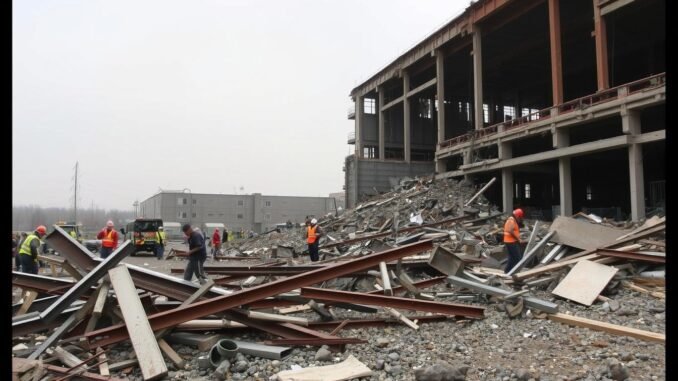

Construction accidents in Quebec are common, with one in five workplace deaths happening on building sites. Recently, a tragic collapse in Blainville has added to these statistics. Syscomax, a well-known construction company, is working closely with two investigations.
The authorities are acting quickly, following strict rules for construction sites in Quebec. They focus on keeping records, following timelines, and controlling the scene. Legal lessons from past cases are also guiding the investigations.
There is a growing concern for public safety. Crime rates in Montreal have increased by about 20% in a year. Syscomax is committed to being open about its practices, from shoring to documentation. We will keep you updated on the investigations, Syscomax’s role, and the importance of safety and accountability.
Breaking Developments in the Blainville Construction Site Collapse
Authorities in Blainville are working with provincial teams after a structural failure at an active site managed by Syscomax. Excavation activities in Blainville have been paused. Officials are following standard Quebec construction protocols to secure the area and plan next steps.
What authorities confirmed about a fatality at the scene
Police confirmed one fatality at the worksite during ongoing construction services. This was after on-site triage and hazard control, following Quebec construction practices. Syscomax said it would help investigators with project management records.
Initial response timelines and emergency coordination in Blainville
First responders set up a secure perimeter quickly. They then stabilized risks so investigators could collect evidence. This approach is common in Quebec construction events, helping departments manage the scene.
Crews paused excavation work and kept access routes open for emergency teams. Syscomax representatives worked with officials to organize construction documents for review.
Early witness accounts and site access restrictions
Witness access was limited to protect the scene and evidence. Officers conducted controlled interviews near the perimeter. Entry points were logged to keep records in line with Quebec construction standards.
Municipal staff in Blainville updated on traffic changes and service impacts. With excavation paused, Syscomax and partners adjusted project management plans. This allowed emergency operations to proceed without routine construction services interference.
Context: Quebec Construction Safety and Public Risk Awareness
In Quebec, construction sites are close to homes and streets. When accidents happen, everyone focuses on safety, records, and how companies talk to the public. People want quick updates and to know how to stay safe.
Why construction incidents spark wider safety conversations in Quebec
Big incidents affect many, including families and businesses. People want clear information and quick answers. In Quebec, this means companies must be open about what’s happening and how they’re keeping everyone safe.
Now, technology tracks who’s on site and what’s being used. This helps confirm what happened quickly. It also encourages safer building practices that prevent problems before they start.
Public-safety trends influencing oversight and enforcement
There’s a push for faster alerts and clearer signs. Inspectors check for detailed records and photos. In Quebec, this means companies must report incidents quickly and clearly.
Companies are now sharing updates in ways everyone can understand. This helps people plan their day and know what to expect from construction.
Community sensitivity to high‑profile incidents across Greater Montreal
When construction stops suddenly, people notice. They want simple messages and to know when things will get back to normal. This is important for sites near schools and hospitals in Greater Montreal.
Trust grows when companies explain what’s next. They might talk about access points or noise levels. This shows how construction can be done safely and with less impact on the community.
Company Profile and Market Position of Syscomax
Syscomax is a top design-build firm and general contractor in Quebec. It starts planning early and keeps a close eye on budgets and safety. Clients in retail, logistics, and manufacturing praise its clear communication and site management.
In a competitive market, pace and proof matter. The firm relies on accurate records and detailed drawings for quality checks. It manages projects by linking planning to on-site actions, ensuring decisions are backed by documents and milestones.
Design‑build firm capabilities and general contractor services
Syscomax combines planning, cost control, and construction expertise from the start. As a general contractor, it oversees trades and site rules, ensuring inspections are ready. This approach reduces hand-offs and boosts accountability.
The firm focuses on early risk assessments, supplier checks, and logistics planning. It tracks schedules and safety reviews, ensuring all aspects work together smoothly.
Commercial construction, industrial construction, and project management
In commercial projects, Syscomax handles fit-outs and envelope upgrades. For industrial work, it focuses on utility connections and access control. Its project management uses short-term planning and cost forecasts to meet site challenges.
Regular meetings and inspections keep tasks on track. This helps the team adapt to weather, supply changes, and local rules without losing key deadlines.
Architectural services, innovative design, and building solutions
Syscomax connects architectural services with constructability reviews. It ensures designs meet budget, schedule, and code standards. The firm supports innovative designs that enhance durability and energy efficiency.
By coordinating designers, trades, and inspectors, Syscomax meets client needs and regulations. It focuses on practical details, clear records, and consistent site management for long-term success.
Dual Investigations: Regulatory Oversight and Police Coordination

After a fatal accident in Quebec construction, two investigations start. One looks at occupational safety rules, while the other checks for criminal acts. Syscomax and its partners need to follow regulatory oversight and handle evidence carefully to avoid problems.
Parallel probes: occupational safety compliance and criminal liability
Inspectors check if the site follows Quebec’s construction rules. They look at training and procedures. The police, on the other hand, search for any criminal acts.
They interview people and look for motives or negligence. Both teams keep their work separate. They record everything and track who has seen what, to protect both investigations.
How dual tracks preserve evidence and timeline integrity
Keeping the site secure from the start is key. This includes sealed areas, logbooks, and careful handling of evidence. Photos, CCTV footage, and other records help keep a clear timeline.
This careful record-keeping helps the regulatory oversight and lets the police investigation check for inconsistencies without messing up the evidence.
Limitations periods and procedural strategy lessons from Quebec cases
Lawyers plan their actions with time limits in mind. In Quebec, administrative steps don’t stop civil cases from moving forward. This means they need to plan ahead, align their actions, and make sure occupational safety findings are kept for future use.
Syscomax
Syscomax says it will follow Quebec’s rules for sharing information. As a design-build firm and general contractor, it sees cooperation as key. It aims to provide safe and reliable building solutions.
Cooperation stance with investigators and transparency commitments
The company promises to give quick access to files and clear updates. It wants to keep facts clear, support investigators, and build trust. This mirrors Quebec’s approach to balancing openness with legal boundaries.
Internal reviews, documentation control, and subcontractor liaison
Internal checks include reviewing important documents and ensuring work is done right. Teams work closely with subcontractors and suppliers. This ensures projects are managed well, as expected from a design-build firm.
Stakeholder updates to clients, insurers, and municipal officials
Syscomax gives clear updates to clients, insurers, and officials. It shares what’s confirmed, what’s not, and how they’re reviewing solutions. This keeps everyone informed and ensures actions match needs and standards.
Site Operations: Excavation Blainville and Work Sequencing Under Review
Experts are looking into how site operations were managed step by step. They are examining planning, execution, and the records that guided decisions. Syscomax and its partners in Quebec construction are detailing their excavation, logistics, and management steps.
Scope, Soil Conditions, and Shoring Approaches
They are comparing the excavation scope with soil conditions and shoring designs. They are checking how earth pressures were managed. The construction company’s plans and field notes are being reviewed.
They are also looking at haul roads, spoil placement, and dewatering. These factors affect stability and safety around the pit. In Quebec, such details are key to safe construction.
Trade Coordination, Crane Logistics, and Temporary Works
They are examining trade coordination through lift plans and equipment access. Crane positions and temporary works are being evaluated. This ensures safety and efficiency on site.
Syscomax teams are documenting hand-offs between crews. This ensures clear coordination and reduces conflicts. It helps manage the project smoothly.
Change Orders, RFIs, and Schedule Impacts During Critical Path Tasks
They are aligning records like RFIs and change orders with schedules. This helps understand changes during excavation work. It shows how decisions were made during fast-paced phases.
Keeping detailed records is a key practice in Quebec construction. It helps tell the story of how the project was managed. It shows how decisions were made without guessing the outcomes.
Regional Footprint: Syscomax Mirabel and Quebec Construction Ecosystem
From its base in syscomax mirabel, the company connects people, materials, and schedules in Blainville and Greater Montreal. This network supports construction services for quick projects and big industrial construction plans. It helps teams keep up with changing plans and stay on track.
Supply‑chain links between Mirabel, Blainville, and Greater Montreal
Syscomax manages local suppliers, concrete, and heavy equipment from Mirabel. This close location means faster delivery to Blainville and Greater Montreal sites. It reduces downtime, keeps crews steady, and supports timely industrial construction and construction services.
Quebec construction regulations shaping site controls
In Quebec construction, rules guide site management. This includes keeping records, tracking access, and meeting deadlines. Following these rules helps keep sites safe and organized.
How regional experience informs risk management on new builds
Experience from syscomax mirabel projects helps manage risks. This includes using surveillance, strong fences, and traffic plans that work with local emergency services. The team balances speed and safety in Greater Montreal. This way, Syscomax creates flexible plans for industrial construction while ensuring responsible construction services in Quebec construction.
Design and Engineering Considerations Affecting Structural Stability
Experts are looking into how the project team balanced cost, schedule, and safety. In a design-build firm, teamwork between architects and engineers is key. They make decisions that affect how loads are transferred and temporary supports are used. Syscomax works within commercial construction norms, combining innovative design with practical solutions that meet Quebec’s standards.
Value engineering vs. safety margins in innovative design
Value engineering aims to use less material or simplify designs. The review checks if safety was kept in mind when making these changes. It also looks at how the design-build firm ensured that temporary works were removed correctly.
Load paths, excavation support, and adjacent‑structure monitoring
Load paths are critical during construction, from foundations to slabs. The team examines excavation support, anchor testing, and dewatering effects. They also monitor nearby buildings, utilities, and streets for any movement that could affect the construction.
Document control: stamped drawings, shop drawings, and field changes
Records show how the design was carried out on site. The team compares stamped drawings to shop drawings and field sketches. This ensures that the built structure matches the approved plans, a common practice in design-build firms.
| Focus Area | Key Documents | Verification Method | Relevance to Commercial Construction |
|---|---|---|---|
| Safety Margins in Innovative Design | Engineer stamps, design memos, VE logs | Peer review notes, calculation checklists | Supports cost control without eroding reliability |
| Load Path Continuity | Structural plans, sequencing diagrams | Field inspections, pour tickets, photo records | Ensures stable transfers during staged erection |
| Excavation Support | Shoring drawings, geotechnical reports | Anchor test results, survey data, settlement logs | Protects crews and adjacent assets in dense sites |
| Adjacent‑Structure Monitoring | Instrumentation layouts, threshold criteria | Inclinometer and crack gauge trends | Limits disruption around urban corridors |
| Change Tracking | RFIs, addenda, site instructions | Revision history, time‑stamped submittals | Aligns field work with approved building solutions |
| Design Intent vs. As‑Built | Shop drawings, redlines, as‑built surveys | Model-to-field checks, sign‑offs by Syscomax | Supports accountability in a design-build firm framework |
Note: The review looks at how documentation practices, when combined with architectural services, help keep track of the project from start to finish in commercial construction.
Safety Culture, Sustainable Construction, and Training Protocols
On construction sites, a strong safety culture is key. Workers need clear rules, simple tools, and steady leadership. A company that focuses on safety training and checklists boosts team confidence.
Site orientations, toolbox talks, and high‑risk activity permits
New workers get a site orientation that covers important basics. Daily toolbox talks remind them of task hazards and safety measures.
For risky activities like excavation or confined space entries, permits are issued. These permits ensure safety controls and plans are in place. Syscomax links these steps to project management checklists for easy tracking.
Sustainable construction practices and their interaction with safety
Sustainable construction means smarter material choices and cleaner methods. It includes waste sorting and using low-emission equipment.
These green practices must pass safety checks. Syscomax reviews each change to ensure safety isn’t compromised.
Third‑party audits, near‑miss reporting, and corrective actions
Independent auditors check compliance and document findings. Near-miss reporting helps the team learn from close calls.
Corrective actions must be documented. With disciplined project management, safety records meet Quebec’s standards. This shows a company’s commitment to safety and sustainability.
Legal and Procedural Landscape in Quebec After Serious Incidents

In Quebec construction, the aftermath of a serious event is guided by the forum, the filing clock, and evidence handling. A clear legal process aids teams like Syscomax in working with regulators, insurers, and police. It also ensures the protection of records and timelines.
Jurisdiction, evidentiary records, and deadlines that shape outcomes
Jurisdiction decides who acts first and how files are handled. Occupational safety teams might inspect a site while police collect evidence. Important documents like time-stamped logs, authenticated photos, and access lists are key.
Digital evidence must have a clear chain-of-custody. This includes cloud backups, device IDs, and supervisor signatures. For Quebec construction projects, keeping track of deadlines is vital.
Distinguishing administrative enforcement from civil liability
Administrative enforcement focuses on compliance and fixing issues, often through inspections and orders. It’s different from civil liability, where claimants seek damages and insurers assess risks. Each has its own set of evidence and solutions.
Because these paths are distinct, legal procedures must align tasks with the correct venue. Syscomax and its partners benefit from early coordination. This ensures safety directives, discovery steps, and disclosure protocols don’t clash.
Lessons from high‑profile Quebec proceedings on timelines
Recent Quebec cases show that moving between forums doesn’t stop limitation periods. A party might meet an administrative deadline but miss a civil one if calendars aren’t aligned. Keeping a strict filing schedule helps avoid this.
Having a structured plan for evidence collection, validation, and storage supports a consistent story from the site to court. For Quebec construction stakeholders, this approach keeps administrative enforcement, civil liability, and any criminal exposure on separate, timely paths.
Crisis Communications and Community Engagement in Blainville
In Blainville, clear information is key for everyone. Syscomax, a general contractor in Greater Montreal, helps with timely updates. These updates respect privacy and investigative needs.
Media coordination, family notifications, and respectful messaging
Public updates should share verified facts and safety measures. Next-of-kin notifications are given first, with careful and human language.
Media briefings in Blainville are short and consistent. They outline confirmed information and note limits to protect evidence.
Neighbourhood access, detours, and business continuity
Traffic and transit plans are best shared early and often. Detours and parking changes need to be mapped with municipal teams in Greater Montreal.
Syscomax works with first responders and property managers. Simple wayfinding and clear signage help shops stay open during construction.
Rebuilding community trust through transparent updates
Trust grows with regular updates and clear explanations. Notes on timeline stages and site safety keep people informed.
By following local protocols, Syscomax shows accountability. In Blainville and Greater Montreal, this approach fosters calm and continuity.
Conclusion
The Blainville site collapse is now confirmed as fatal. It has entered a dual-investigation phase. This reflects Quebec’s legal reality. The path forward will be shaped by jurisdiction, limitation periods, and strict evidence rules.
Lessons from the Mike Ward–Jérémy Gabriel case are relevant. They show how administrative and civil tracks run in parallel. Outcomes depend on preserved records and clear timelines.
In Montreal, crime has risen by 20%. The province is responding to high-profile violence. This includes the Rivière-des-Prairies case. Syscomax has promised to cooperate while keeping documents in order.
This approach is important in Quebec construction. It helps maintain community trust. Syscomax must balance schedule pressure with rigorous controls.
They need to manage site files and changes carefully. Syscomax can boost public confidence. They can do this by supporting investigations and planning for safe work.
Looking ahead, the sector will watch how design and building solutions are used. If records are kept and updates are timely, investigators can do their job. The community will see how lessons shape future builds.
In this way, Syscomax and Quebec construction have a chance to show responsible practice. They can do this by using evidence, empathy, and continuous improvement.

Be the first to comment