
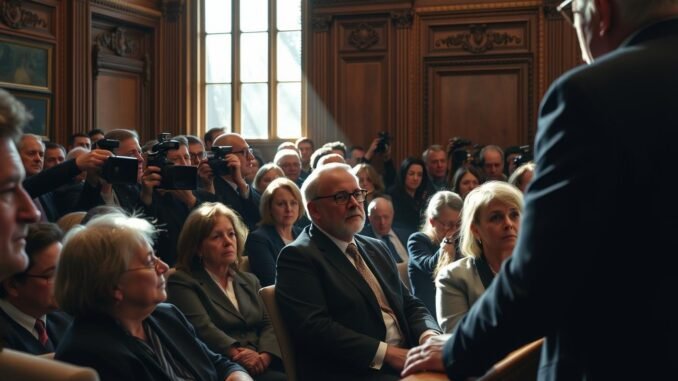

In Canada, one in three civil cases depend on who you believe, not just evidence. This was clear in the Montréal trial. A key witness spoke clearly, drawing everyone’s attention.
The Gilbert Rozon trial is now a big deal in Canadian court news. It covered timelines, consent, and memory issues. Lawyers argued over a June 1980 date, while the judge kept track of everything.
Nine women are suing for nearly $14 million, making the case very interesting. It’s happening in the #MeToo era, with new laws making it easier to seek justice. Director Dominic Champagne and artist Patricia Tulasne were there, adding to the buzz.
The trial is a chance for Gilbert Rozon to face a civil court. It’s about who you believe and what makes sense. This first day showed how important it is to listen carefully to what’s happening.
Key witness recounts pivot moment in courtroom as proceedings intensify
The day started with calm, precise testimony that caught everyone’s attention in Montréal. Lawyers focused on consent and timelines, seeking clarity. The gallery watched every detail, and reporters noted the dynamic witness credibility.
Steady voice, clear details: how testimony shaped the day
A measured delivery set the pace. Dates linked to early Just for Laughs preparation were revisited. Specific settings were tested against memory.
Each short answer changed how the room saw the witness’s credibility, even before exhibits appeared. Observers noted the importance of simple, concrete language. When facts were tight, the story felt stable. When wording was softer, the meaning was more profound.
Lawyers’ focus on timelines, consent, and memory gaps
Questions focused on consent and timelines. Counsel mapped out sequence, place, and follow-up. Cross-checks compared earlier statements to today’s words, highlighting small gaps.
Legal updates in Canada showed why private events rely on memory. Sophie Gagnon’s advice on memory decay was echoed in court. Targeted prompts tested what could be recalled without guessing.
Real‑time perception shifts in a Montréal civil trial
The room’s view changed with each moment. A pause could make a point stronger; a careful hedge could change it. Visual cues and brief clarifications structured the discussion, keeping pace with the Montréal proceedings.
Local coverage captured these shifts and how they might be seen by an actress or producer in the audience. With each exchange, the story evolved through the lens of courtroom testimony and credibility.
Inside the cross‑examination: credibility, tone, and memory under pressure
Pressure grew as lawyers focused on small details. They used a special Canadian courtroom style. This style is all about how answers change with careful wording.
Witnesses were tested on their credibility. They were asked about dates, places, and remembering casual talks from years ago.
Bruce Johnston’s approach to contradictions and precise wording
Bruce Johnston took a careful approach. He looked for exact words on attraction comments and work behavior. Then, he compared these to earlier statements.
He used simple questions to get full stories. But, he also cut them down to the essential parts.
This method helped him track changes in meaning. Each repeated sentence was a key point for testing credibility. It made the record clear without adding bias.
Testing recollection with dates linked to the 1980 Annick Charette account
Johnston tied questions to June 1980 and the Annick Charette account. He asked about the order of events. This helped memory match a fixed timeline.
When there were gaps, he compared them to earlier details. This method is like how courts test long-term memory. It uses simple things like clocks and named months to keep recall accurate.
How calibrated tone and phrasing affect answers in Canadian courtrooms
The way questions were asked mattered a lot. A calm, Canadian courtroom tone often got more details. Soft phrasing led to context, while strict phrasing got a single point.
This careful use of tone was a key strategy. It shaped what was recorded. It also prepared for comparisons with visual evidence and references to a theatre artist. This kept the spoken memory and visual context in line without going too far.
Visual evidence at issue: videos, photos, and the Outremont property debate

Jurors and observers saw how visual evidence shapes a narrative about place. At the centre is an Outremont property where sightlines, fences, and neighbouring façades matter. A careful review links a 1994 video to family photos 1998–1999, forming a timeline used in a Canadian investigation.
1994 home‑interview footage and landscape visibility indicators
A 1994 video recorded during a Just for Laughs home interview captured lawn edges, stonework, and early plant growth. Viewers could note fence lines, gaps between hedges, and how neighbouring façades appeared from the yard.
Lawyers disagreed on whether the trees were already mature. They paused frames to track where a path turned, where a corner opened, and how sightlines across the Outremont property shifted with angle and light.
Family photos from 1998–1999 and evolving sightlines
Later albums added context. The family photos 1998–1999 showed birthdays and winter gatherings, including a tall fir near the patio and a decorative shrub by the walkway.
Seasonal contrasts—snowpack versus summer light—made density and cover easier to compare. Notes referenced late‑1990s patio work that could change what a person might see at the corners.
When images corroborate—or challenge—narratives about place and time
Side‑by‑side stilts, arrows, and annotated branches turned casual footage into a working map. Together, the 1994 video and the albums built a record that interacts with testimony in a Canadian investigation.
The approach mirrors how reporters track a filmography: frame by frame, year by year, to test claims tied to dates and locations on the Outremont property.
Workplace conduct disputes at Just for Laughs and festival‑season context
At Just for Laughs headquarters, daily life was fast-paced and full of laughter. The Montréal festival season made things even busier. Staff worked in an open‑plan office, where privacy was scarce.
The trial record places emphasis on how the office actually worked. Emails, meeting notes, and travel approvals were read alongside event schedules. Lawyers asked how proximity, access badges, and room bookings shaped interactions. The aim was to map what could happen in a space designed for quick collaboration.
Open‑plan offices, proximity, and professional boundaries
Desks were close together in the open‑plan office. This layout encouraged teamwork but made personal space hard to find. Some staff found it great for teamwork, while others felt it made it hard to report issues.
Managers had to be available on busy days. They worked in shared areas, took quick huddles, and greeted talent on the fly. This made it hard to know if a brief interaction was normal or not.
Calendars, seating plans, and power dynamics in a busy headquarters
Calendars, seating charts, and production logs were examined to trace authority and traffic. Power dynamics surfaced in who approved travel, who controlled rooms, and who could grant guest access. During the Montréal festival season, a single change to a seating plan might shift who sat near decision‑makers.
Questioning also touched on named staff, including Mary Sicari, to anchor specific dates and tasks. In a bustling headquarters, a chart could show formal roles while daily practice diverged. That contrast was tested against emails and sign‑in records to see how influence moved minute by minute.
How complainant and witness accounts intersect with business rhythms
Several accounts linked alleged moments to peak booking windows and sponsor events. The rhythm of the city—press calls, tech checks, and late‑night showcases—framed when people met and where they stood. The 2017 financial fallout, with sponsor withdrawals and subsidy freezes, reshaped staffing and visibility, adding pressure to already tight corridors.
Some artists and public figures passed through, including the occasional Canadian actress attending press or gala tapings. Their presence added to traffic and timing puzzles. When schedules shifted, staff pivoted, and those pivots formed the backdrop for how each account was placed in time.
| Operational Focus | Evidence Used | Observed Effect on Interactions | Relevance to Power Dynamics |
|---|---|---|---|
| Desk Layout in Open‑Plan Office | Seating plans, floor maps, security paths | Higher proximity and frequent unplanned contact | Visibility of decision‑makers affects access and tone |
| Festival‑Week Scheduling | Calendars, call sheets, venue holds | Compressed timelines raise pace and noise levels | Control of time slots signals seniority and leverage |
| Room and Guest Access | Badge logs, reception notes, email approvals | More drop‑ins by talent and partners | Gatekeeping power influences who meets whom |
| Sponsor and Media Pressure | Contracts, press grids, crisis memos post‑2017 | Shifts in staffing and visibility across teams | Resource control intensifies hierarchical lines |
| Witness and Complainant Timelines | Emails, travel records, meeting notes | Specific moments tied to busy corridors and events | Authority mapping clarifies consent and escalation routes |
Consent, contradiction, and civil standards in the Annick Charette account

The case is about understanding words, dates, and actions in court. It’s about memories from 1980 and what consent in civil law means when both sides disagree. The goal is to be clear without going too far.
Lawyers look at June dates from the Grande Virée de Lachute. They examine contact, setting, and sequence. Annick Charette says there was no consent in 1980. Gilbert Rozon claims it was consensual. They debate who moved first and how language set expectations.
From criminal acquittal in 2020 to civil scrutiny based on probability
The case has a 2020 criminal acquittal, which had a strict standard. Now, the civil court uses the probability standard. This change changes how they look at testimony, cross-examination, and exhibits.
Competing versions of a 1980 encounter and their legal weight
The 1980 timeline is closely examined. Counsel focus on what was said, when, and how actions matched words. Annick Charette and Rozon have different stories. In civil court, credibility, context, and corroboration are key under the probability standard.
Prior rulings, public understanding, and narrative credibility
Earlier decisions and media coverage influence public opinion. Yet, the current case builds its own evidence. Lawyers compare memories to calendars, events, and career milestones, like being a voice actor. They aim to see if each story fits within Canadian consent standards in civil law.
Dominic Champagne’s presence and the arts community’s response
Dominic Champagne sat in the gallery, showing the Montréal arts community was keenly watching. His presence linked the courtroom to the world of theatre, where trust and safety are key. In theatre, leaders set the tone for how standards evolve.
Why an industry figure attended and what it signalled to theatre circles
As a well-known Canadian artist, he watched closely as the case unfolded. His attendance was seen as a call to action in theatre circles. It sparked discussions on institutional change based on real-world experiences.
Comments on justice, culture, and institutional change
He spoke about the need for fairness in outcomes, aligning ideals with daily work. The Montréal arts community heard a call for better intake, trauma-aware training, and clear language on harm. These ideas aim to improve the industry beyond one venue.
Implications for Montréal programming, policies, and training
Teams across the industry considered how to adapt programming and policies. They looked at values-aligned curation, content advisories, and workshops on rights and duties. This includes town halls, peer mentorship, and funding tied to conduct codes.
- Programming and policies: values checks, advisory notes, and escalation maps.
- Training: bystander skills, consent modules, and supervisor refreshers.
- Governance: independent intake, audit trails, and published annual metrics.
- Community dialogue: open forums that include artists, crew, and staff.
These steps aim to create lasting habits in the Montréal arts community. They show how courtroom scrutiny can shape theatre practices, focusing on prevention, clarity, and care.
Patricia Tulasne
Media follow every move in the Montréal civil case closely. They also look at artists whose careers add to the story. Patricia Tulasne is a well-known Canadian actress and theatre artist. Her biography and filmography are often mentioned, showing her place in the arts.
Canadian actress and theatre artist in the spotlight amid trial coverage
Patricia Tulasne is often mentioned in the news because people know her work. Her fame means she gets extra attention as latest news mixes legal updates with cultural insights. The focus is on her professional achievements and staying relevant in public life.
Biography notes: stage performer and voice actor with a diverse filmography
Her biography is deeply rooted in Québec’s performance traditions. As a Canadian actress and voice performer, she has worked in TV, film, and stage. This diverse filmography explains why she’s often mentioned in discussions about the arts.
Awards, latest news, and how a Canadian artist navigates public scrutiny
Coverage highlights awards and career milestones to understand her standing. When latest news emerges, people look for context. For Patricia Tulasne, her creative work remains the main focus of public interest.
Media context touching on “patricia tulasne et son conjoint” and career arcs
Entertainment sections often mix personal and professional stories. This is why there’s interest in “patricia tulasne et son conjoint.” Reports focus on her work as a Canadian actress and theatre artist. They note how her filmography and awards shape her career.
| Focus | Relevance to Coverage | What Audiences Learn | Keywords in Context |
|---|---|---|---|
| Biography | Places Patricia Tulasne within Québec and Canadian arts | Background on training, roles, and voice work | Patricia Tulasne, biography, Canadian actress |
| Filmography | Maps credits that are cited in cultural reporting | Range across TV, film, and stage performances | filmography, theatre artist, patricia tulasne |
| Awards | Signals peer recognition amid heightened interest | How honours shape a public profile | awards, Canadian actress, Patricia Tulasne |
| Latest news | Links ongoing media attention to her career context | Why her name surfaces during trial reporting | latest news, patricia tulasne, theatre artist |
| Personal interest | Explains searches for “patricia tulasne et son conjoint” | Media note the curiosity while centring professional work | patricia tulasne et son conjoint, biography |
Legal backdrop and access to justice: from class action to joined civil suits
The journey to this joined civil trial started when the Quebec Court of Appeal closed the class action door but opened individual paths. The class action denied in the Les Courageuses case allowed claims to move forward under Canadian legal standards. This change shifted strategies, evidence, and the speed of hearings, focusing on access to justice for all parties.
Nine women seeking nearly $14M after class action was denied on appeal
Nine women are now seeking nearly $14M in damages after the class action denied in the Les Courageuses case. Their cases were merged into one joined civil trial. This allows them to share common facts efficiently without losing the unique details of each story.
Abolition of time limits and defence challenges to constitutionality
Quebec’s reforms abolished time limits for civil sexual assault claims, making it easier to seek justice for past allegations. Defence teams are challenging this, saying it could lead to unfair trials due to fading memories and lost records. The court will consider these arguments within Canadian legal standards.
Dozens of witnesses building an evidentiary record beyond earlier cases
Dozens of witnesses, including former Just for Laughs staff, are creating a unique record. Their testimonies, cross-examinations, and documents paint a detailed picture. This approach aims to meet Canadian legal standards by proving things on a balance of probabilities.
Public, high‑profile proceedings and the difficulty of trauma‑centred trials
These trials are open to the public and get a lot of media attention. This adds pressure on everyone involved. The challenge is to handle trauma-centred testimony while following the rules of a joined civil trial. This is a key part of modern access to justice and the legacy of the Les Courageuses case.
Conclusion
Today’s Montréal civil trial update sheds light on the Gilbert Rozon case. The court looked at witness statements, videos, photos, and work records. They followed Canadian court standards for accuracy.
They checked dates, including June 1980, against images from an Outremont property and Just for Laughs office routines. This shows how important tone, memory, and evidence are in court.
The legal process is key. After a 2020 criminal acquittal and the end of civil action time limits, the focus is on probability, not absolute proof. The defence will argue against these changes, saying they are unfair as time goes by.
In this stage, Canadian court standards help the judge review detailed facts. Each witness adds more to the story. This is how the case unfolds.
Outside the courtroom, there are cultural impacts. The involvement of Dominic Champagne and coverage of artists like Patricia Tulasne are making theatres and festivals rethink their policies. Media in Montreal and Canada keep us updated on the trial’s progress and its effects on the arts.
This Montréal civil trial update shows a simple truth: credibility is built step by step. The court moves from claims to solid evidence through careful questioning and exhibits. The next steps will test how well each piece of evidence holds up and how it affects the outcome in Canadian courts.

Be the first to comment