
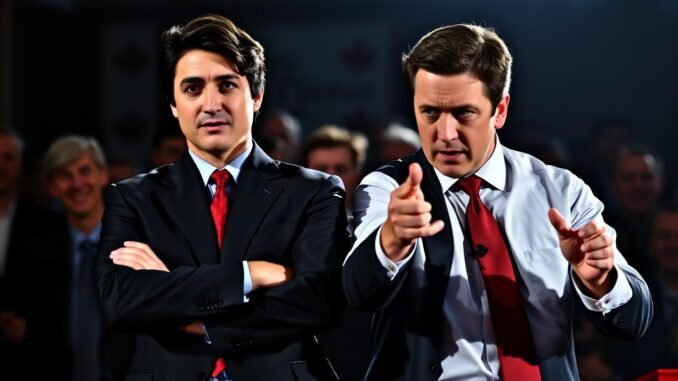

Five points is the new Léger gap, putting the Liberals ahead of the Conservatives. This change happened after a year where many thought the Conservatives would win big. The shift is making people rethink how to read canadian political polls this fall.
Changes in the political landscape have been fast. Nova Scotia MP Chris d’Entremont joined the Liberals. Alberta MP Matt Jeneroux is stepping down. Also, at least two Quebec Conservatives are talking to Mark Carney’s team. Now, the Liberals are just two seats away from a majority, aiming for 172.
The mood of voters has changed with these events. The Carney Budget also played a role. Pierre Poilievre is strong among Conservatives, but Mark Carney leads in preferred prime minister polls by a big margin. This difference in popularity is making people focus on the leaders’ images and tones.
Earlier, the Conservatives were up by more than 20 points. But, talk of U.S. politics, caucus issues, and a possible leadership review cooled their lead. Most think the budget will pass and there won’t be an early election. For now, polls show a tight race, rising uncertainty, and a new test for canadian political polls.
Latest shifts in Canadian political polls and what’s driving them
In a week, the momentum has shifted. Analysts say leadership tone, caucus stability, and budget expectations are key. The balance in polls now reflects changes in party rooms and on the campaign trail.
How a tightening race reframes election predictions
A recent Léger poll shows the Liberals leading by five points. This change has cooled early election predictions. Now, many think the Carney Budget will pass, and non-confidence attempts will stall.
Voters are considering policy and tone. Mark Carney’s approval ratings are high, and Pierre Poilievre’s sharp words have changed the polls. This shift rewards steady language and solid fiscal plans in polls.
Government poll standings after recent defections
Chris d’Entremont joined the Liberals, and Matt Jeneroux resigned. This has tightened numbers in Ottawa and reduced the Conservative caucus. The Liberals are now just two seats from a majority, and polls quickly caught the shift.
Talk of more defections adds to the uncertainty. Critics say mid-Parliament moves are undemocratic. Yet, these changes highlight CPC issues and make election predictions more cautious.
What leadership race updates signal to voters
Leadership updates are now key for voters. Poilievre faces a review in January, similar to Erin O’Toole’s end. The Liberals’ stability contrasts with Conservative debates, seen in polls.
With the NDP cautious about an election, voters value calm budgets over risky moves. This trend is shaping election predictions and narrowing the path for sudden changes.
| Driver | Recent Development | Effect on canadian political polls | Impact on election predictions | Signal in government poll standings |
|---|---|---|---|---|
| Leadership Tone | Carney’s approvals above 50% in several polls; Poilievre’s combative rhetoric | Boosts Liberal perception of steadiness | Raises odds of budget passage; lowers odds of snap vote | Liberal edge grows in urban battlegrounds |
| Caucus Stability | d’Entremont crosses to Liberals; Jeneroux resigns | Conservative support softens at margins | Models shift from majority talk to minority scenarios | Liberals move within striking distance of majority seats |
| Policy Credibility | Expectation that the Carney Budget passes | Centrist voters drift to Liberals | Projects fewer non-confidence risks | Stabilizes Liberal share in key regions |
| Party Internal Reviews | Upcoming leadership review for Poilievre | Introduces uncertainty for CPC trendlines | Temper enthusiasm in long-range forecasts | Mixed signals, with modest Conservative dips |
Bottom line for readers of leadership race updates: watch how internal moves, not just campaign ads, keep steering liberal vs conservative polls and, in turn, the evolving government poll standings.
poilievre vs trudeau polls
Recent changes in leadership are changing how Canadians view polls. The race is getting closer, with voters focusing on economic promises versus stability. A detailed look at polling data shows who’s gaining and losing support each week.
Why voter intention is narrowing: a roundup of recent data
The Liberals now lead by a few points, reversing a trend of Conservative leads. Mark Carney’s entry has sparked interest among moderates. Pierre Poilievre’s base remains strong, but the gap is narrowing in cities and the Atlantic.
Abacus data shows Poilievre does well with Conservatives, but Carney is more popular as a prime minister. This difference is key in polls that change from month to month. It shows how image, tone, and voter turnout matter.
Comparing trends across Canadian political polls
Volatility is seen across polls, but most agree the gap is narrowing. Léger finds a small Liberal lead, while others see a smaller difference. The popularity of candidates is key, with Carney’s numbers improving and Poilievre’s declining among undecided voters.
In Ontario suburbs and Montreal, support is more stable. These areas see the biggest changes in polls, making late campaign efforts and grassroots work critical.
How regional dynamics and party loyalty affect results
In Quebec and Atlantic Canada, Conservative support is softer. Rumours of caucus issues and defections like Allan d’Entremont’s in Nova Scotia add to the challenge. Yet, Western ridings remain strong for the Conservatives, making Poilievre’s path uncertain.
Conservatives have an edge in turnout, but a divide within the party complicates things. In close races, small shifts in popularity can sway the outcome. Polls show this delicate balance in action.
Léger poll Trudeau surge and the implications for Conservatives
The latest leger poll trudeau results show a big change in mood. Experts say this change is due to Trudeau’s more centrist policies. These include softer stances on trade, immigration, and taxes.
Reading the Léger data: Liberals leading by five points
The Liberals now lead by five points in national polls. This is thanks to gains among moderates and city voters. These numbers also show a narrowing gap in key suburban areas.
From near-certain Conservative majority to Liberal momentum
Not long ago, most thought the Conservatives would win a majority. But then, caucus issues like Chris d’Entremont’s move and Matt Jeneroux’s plans raised doubts. This, along with the Liberals’ centrist message, has changed the election map.
Political candidate popularity versus party preference
Now, who the leader is matters a lot. Mark Carney is seen as a better prime minister than Pierre Poilievre. This difference affects polling data comparison and election predictions across the country.
Abacus snapshot: leadership favourability and electability

Abacus Data’s latest findings paint a dynamic picture of leadership favourability and electability. Pierre Poilievre shows strong numbers against other Conservative candidates, like Ontario Premier Doug Ford. Yet, when it comes to appeal across parties, opinions are mixed.
Context matters. The survey came before a Conservative defection and a resignation. These events can change how people see candidates. Poilievre’s chances of winning seem better within the party, but his wider appeal is uncertain.
Mark Carney’s approval ratings are high in many polls. He’s seen as a strong contender for prime minister. This contrast shows how different polls can show different things. For voters, the signals are mixed, and the outcome depends on the candidate’s message.
Abacus Data’s snapshot suggests Poilievre has a short-term advantage. But, party issues, defections, and speeches can quickly change this. Ongoing polls will help understand Poilievre’s chances as the race unfolds.
| Measure | Pierre Poilievre | Mark Carney | Doug Ford | Key Insight from Canadian Political Polls |
|---|---|---|---|---|
| Party-base preference | Stronger among CPC members and leaners | Limited among CPC base, broader cross-party curiosity | Lower than Poilievre within CPC options | Political candidate popularity splits by partisan loyalty |
| Cross-party appeal | Mixed outside CPC | Higher among centrists and soft Liberals | Regional pockets, uneven nationally | Electability hinges on moderates and swing voters |
| Preferred PM gap | Trails in several recent reads | Leads in multiple surveys | Not competitive at the national level | Polling data comparison shows leadership matchups matter |
| Short-term trajectory | Has wiggle room before review | Upward trend in approval | Stable to soft | Leadership race updates can alter momentum quickly |
Pierre Poilievre’s chances of winning depend on a clear message and keeping the party base. With updates coming often, it’s key to keep watching the polls closely.
Inside Conservative Party news: caucus unrest and leadership review
New issues in the caucus are changing the story in conservative party news. These changes come as the government’s standing in polls is tight. The popularity of political candidates can shift quickly.
Floor crossing and resignations: what they mean for party unity
Chris d’Entremont joined the Liberals, unhappy with Pierre Poilievre’s leadership. Two days later, Matt Jeneroux quit. There’s talk that two Quebec MPs are talking to Mark Carney’s team.
These moves test the party’s unity and message control. Media coverage of these events affects election predictions and polls. It also puts pressure on organizers to keep track of candidate popularity.
How secret-ballot dynamics could shape the leadership review
The leadership review in January will be a secret ballot vote for all members. Private votes can differ from public support, as seen with Erin O’Toole.
MPs might praise Poilievre in public but vote for change privately. This could change government polls and election predictions quickly, based on candidate popularity.
Progressive Conservatives versus social conservatives: the big-tent strain
The old split between Red and Blue Tories has grown more apparent. Critics say Poilievre’s style is pushing moderates to the Liberals. Yet, social conservatives remain loyal to him.
Leaders like Brian Mulroney and Stephen Harper once balanced these factions. Today, debates over tone, policy, and caucus process are critical. They show why conservative party news and leadership updates are as important as polls and candidate popularity.
| Faction | Key Priorities | Perceived Risk | Potential Impact on Polls |
|---|---|---|---|
| Progressive Conservatives (Red Tories) | Fiscal prudence, pragmatic climate policy, institutional stability | Alienation by populist rhetoric; drift to Liberals under Mark Carney | Could lift government poll standings for Liberals and reshape election predictions |
| Social Conservatives (Blue Tories) | Law-and-order, family policy, energy development | Narrow appeal beyond core; turnout risk in suburban seats | Stabilizes base but may cap political candidate popularity with swing voters |
| Strategic Centre within CPC | Message discipline, coalition-building, urban outreach | Internal backlash if compromises dilute core values | Improves competitive edge in government poll standings if unity holds |
Liberal Party trends under Mark Carney
Mark Carney has brought a steady, practical approach to the Liberal Party. The party now focuses on stable management and softer language. This shift is helping to close the gap in polls, making the party more appealing in suburban areas.
Centre-right repositioning and policy pragmatism
The party has moved towards the centre-right on issues like trade, immigration, and taxes. Carney has also toned down some of the party’s more divisive stances. This approach aims to balance fiscal plans with a more moderate tone.
This new direction has boosted the party’s image among soft Conservatives and swing Liberals. In polls, Carney’s approval rate has hit 50% in several regions, a significant achievement.
Why moderates are shifting: tone, strategy, and platform changes
Moderates are drawn to the party’s calm language and detailed proposals. The party’s focus on results and clear stances on climate and competitiveness is also appealing. This has helped the party win over suburban families who value practical issues over party politics.
This shift in voter sentiment, combined with the party’s grassroots efforts, is opening up new paths in Ontario and Atlantic Canada. It suggests a more hopeful outlook for the party’s chances in the next election.
How close the Liberals are to a majority and what comes next
With Allan MacMaster d’Entremont’s switch, the Liberals are just two seats away from a majority. The party is quietly trying to win over more defectors. The party’s focus is on building a strong team for the next budget.
Recent polls show the party gaining ground in areas with high voter turnover. Carney’s popularity as a preferred prime minister is also growing, which could influence election predictions.
| Metric | Current Signal | Implication for Liberals | Implication for Conservatives |
|---|---|---|---|
| Approval (Carney) | Above 50% in several polls | Stronger leadership contrast and moderate appeal | Pressure to broaden message beyond core base |
| Preferred PM in carney poilievre polls | Leads in urban-suburban corridors | Better conversion in seat-rich areas | Need to rebuild in 905 and Metro Vancouver |
| Government poll standings | Up after floor crossing | Two seats from majority via caucus growth | Heightened focus on caucus unity |
| Policy positioning | Centre-right pragmatism on taxes and energy | Lower resistance among fiscal moderates | Reduced space to attack on economic stewardship |
| Election predictions | Tighter race with regional volatility | Opportunity to lock swing ridings | Must expand appeal to suburban moderates |
Note: Signals synthesize recent public polling and reported caucus movements to highlight trajectory, not outcomes.
Polling data comparison: leadership tone, rhetoric, and voter reactions
In canadian political polls, tone is key. A clear comparison shows how leaders’ language builds trust or raises doubts. Voters in polls like poilievre vs trudeau weigh the intensity of messages against their steadiness.
Recent surveys highlight how sharp rhetoric on topics like immigration and the CBC affects different regions. The way leaders speak about these issues can make them more or less popular. This is seen in how approval and preferred-PM numbers change.
Mark Carney’s calm and practical approach has boosted his approval and standing as a preferred PM. Pierre Poilievre’s bold style keeps his base loyal, showing his strength among Conservatives. Yet, many feel tired of the constant conflict, even during tough economic times.
Debates over the RCMP and past ethics issues against Justin Trudeau have made the debate louder. Political scientists say that U.S.-style rally chants get strong reactions, both positive and negative. In polls, this often means high enthusiasm but also more resistance.
Abacus tracking shows Poilievre as the top Conservative choice, despite the need for moderation in uncertain times. Léger’s numbers show a five-point Liberal lead, reflecting a desire for stability. Yet, polls vary on how lasting this preference is.
Clarity is key. Voters respond well when leaders’ tone matches their policies and when their words match the situation.
A detailed look at polling data reveals why some leaders are more popular than others. When leaders strike a balance between being firm and respectful, they gain support from more people. This approach helps Pierre Poilievre and others build a broader base of support.
| Measure | Tone and Rhetoric | Observed Voter Reaction | Impact in Canadian Political Polls |
|---|---|---|---|
| Approval | Calm, pragmatic delivery | Higher trust among moderates | Stronger centre support; steadier trend lines |
| Preferred PM | Policy focus over slogans | Lower resistance, broader appeal | Lead expansion in urban and suburban regions |
| Base Enthuasiasm | Combative, rally-style messaging | High turnout intent among core voters | Solid floor in poilievre vs trudeau polls |
| Swing Reaction | Institutional respect and measured tone | Positive shift among undecideds | Incremental gains across tracking waves |
| Electability Signal | Balanced critique with clear plans | Reduced polarization costs | Improved political candidate popularity and pierre poilievre chances of winning benchmarks |
Carney vs Poilievre polls and the evolving battleground

Recent polls in Canada show a changing landscape. Analysts see big differences in what candidates promise. These polls also show how public mood shifts over time.
Leader-to-leader contrasts in approval and image
Mark Carney leads in polls, with more people approving of him. He’s seen as the preferred Prime Minister. His support is strong, changing how people see the election.
Pierre Poilievre, on the other hand, has a dedicated base. He does well in polls against other Conservatives. Yet, his chances in bigger races are up for debate. This mix explains why polls show different stories.
Issue salience: economy, immigration, energy, and governance
Voters are looking at what candidates promise and if they can deliver. The Liberals focus on long-term economic growth. Critics say they lack clear plans and spend too much.
On issues like immigration, energy, and governance, the Liberals offer a balanced approach. But, a more aggressive stance is also appealing. Polls show that voters value both calm and decisive action.
From populism to pragmatism: what resonates with swing voters
Swing voters prefer clear plans and steady words. The influence of U.S. politics has made some Canadians seek less divisive messages. This is why tone matters a lot in polls.
Getting people to vote is key. Poilievre’s supporters are eager to vote, while the Liberals lead in some polls. The election will depend on who focuses on everyday costs or practical solutions.
What defections reveal about party identity and voter alignment
Leadership race updates show big changes with Chris d’Entremont crossing the floor and Matt Jeneroux resigning. These actions highlight a long-standing divide within the Conservatives. It’s between those who are more practical and those who are socially conservative.
This division goes back to the 2003 merger. It continues to affect how people see the party’s true identity.
According to conservative party news, talks between Conservatives and Liberals, including Quebec MPs, are ongoing. They are discussing joining forces under Pierre Poilievre. But, a more extreme tone might lose some voters, while a more moderate approach could attract them.
In Ottawa, the numbers are key. The Liberals are just two seats away from a majority. This is thanks to some members moving to the Liberals. A recent poll shows the Liberals are five points ahead, which adds to the momentum.
These changes are also seen in liberal vs conservative polls. Red Tories and moderates are drawn to the Liberals’ message. On the other hand, the CPC is becoming more united in its beliefs. Pollster Frank Graves compares this to the U.S. Republicans, which affects how Canadians view the parties.
Experts say these changes will be felt during any leadership review. The balance between being practical and populist will cost the party in seats and support. For voters, it’s clear: keep an eye on defections, the tone, and leadership race updates to see where each party is headed.
Conclusion
Canadian political polls show a close race, but a shift in momentum. A new Léger poll has the Liberals up five points, thanks to Mark Carney’s leadership. They also have high approval ratings in many surveys.
There’s trouble in the Conservative party, with some MPs thinking of leaving. This makes it easier for the Liberals to pass the Carney Budget. Now, election predictions focus more on leadership and practical policies.
Abacus Data says Pierre Poilievre is the top choice for Conservatives. But, a leadership review in January could be risky. The fight is now about image, not just votes.
Recent polls show voters prefer calm leadership over sharp populism. This is important for Poilievre’s chances of winning.
Looking at polls across Canada, the Liberals are gaining ground. They’re winning over suburban and centrist voters. These small gains could make a big difference in key areas.
Overall, polls show a tight race with many factors at play. Leadership, party unity, and clear policies are more important than just making headlines. As parties adjust their messages, the election will depend on who can manage the country’s challenges best.

Be the first to comment