
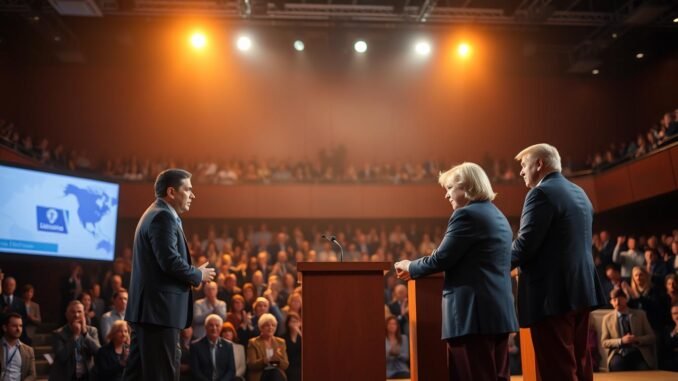

One in five Canadian jobs rely on exports to the U.S. This fact set the stage for a tense debate in Montreal. Four candidates outlined their plans to face Donald Trump’s tariffs and sovereignty challenges. The debate was fast-paced, but the stakes were high.
Mark Carney, Chrystia Freeland, Karina Gould, and Frank Baylis all agreed on a key strategy. They proposed dollar-for-dollar retaliation and a stronger economy. They also suggested increasing defence spending quickly. The debate stayed civil, with a focus on differentiating themselves from Pierre Poilievre.
The debate was moderated in English by Hannah Thibodeau, following a French debate. It provided a clear view of the candidates’ positions in Canadian politics.
Carney emphasized his experience in handling crises, like the Great Recession. He proposed using AI and energy strategy to grow the economy. Freeland highlighted her experience in trade battles, suggesting targeted counter-tariffs with allies.
Gould focused on urgent defence needs and a united provincial plan. Baylis advocated for strong counterattacks and leveraging borders. With voting open and March 9 approaching, these debates could shape the leadership race.
The debate raised a critical question: who can stop tariffs, keep supply chains flowing, and offer hope? This debate tested the candidates’ abilities and highlighted the risks of failure.
Setting the stage: a high-stakes liberal leadership debate centred on Trump and Canada’s future
In Montreal, a key debate took place under the spotlight. It was fast-paced and had big stakes. The debate focused on how to handle Donald Trump’s threats and Canada’s future.
This event was part of a series of debates across Canada. It helped shape the election and leadership discussions.
Why Trump’s tariffs and sovereignty taunts dominated the evening
A 25% tariff on Canadian goods was a major topic. Trump’s comments on Canada being a “51st state” added to the urgency. The moderator pushed for detailed plans on how to respond.
Candidates agreed on a strong response to tariffs. They also talked about strengthening the economy and defence. But, they had different ideas on how to deal with the U.S.
The Montreal English-language debate in a compressed leadership race
The debate followed a French-language one, making the contrasts sharper. The format allowed for quick, focused answers. This helped voters see who was ready to lead.
With polls showing Mark Carney’s popularity, the debate was intense. Candidates aimed to stand out in the race, which could end soon.
How candidates balanced unity with contrasts on policy and tone
Candidates agreed on retaliating against tariffs but differed on other issues. They discussed how to pressure the U.S. without hurting Canada. This led to a mix of unity and diversity in their plans.
The debate stayed focused on strategy. This made the discussions feel real and relevant, not just abstract ideas.
| Debate Focus | Shared Ground | Key Contrasts | Voter Takeaway |
|---|---|---|---|
| Tariffs and Sovereignty | Dollar-for-dollar retaliation; protect supply chains | Choice of U.S. pressure points and pacing of actions | Preparedness to defend Canadian workers and exporters |
| Security and Defence | Stronger CAF and allied coordination | NATO target timelines and procurement fixes | Practical paths to meet commitments |
| Economy and Climate | Growth with industrial strategy | Carbon policy design and investment focus | Balance between affordability and ambition |
| Campaign Readiness | Unified message against Trump’s risks | Tone, tempo, and coalition-building tactics | Clarity within canada political debates for fast cycles |
Defending Canada from Trump’s tariffs: dollar-for-dollar retaliation and strategic pressure points
The debate on cross-border trade got intense. Liberal candidates emphasized the need for quick action and stable supply chains. They want to show strong leadership and win public support through smart strategies.
Consensus on retaliatory tariffs with “maximum impact” in the U.S., minimal pain in Canada
All four candidates agreed on dollar-for-dollar tariffs. They see it as a careful defense, not a harsh attack. The goal is to hit the U.S. hard but protect Canadian families and small businesses.
They linked this to debates on resilience and fairness. By using trade strategies that have worked before, they aim to keep markets stable and jobs safe.
Targeted hits: Wisconsin dairy, Florida orange juice, and Tesla as leverage
They highlighted key targets: Wisconsin dairy, Florida orange juice, and Tesla. These choices, they said, use tariffs to pressure the U.S. without hurting Canadian goods.
Karina Gould suggested that consumers can make a difference. By avoiding Florida orange juice and reconsidering travel there, they can influence the debate and election strategies.
Mobilizing U.S. industry lobbyists to force a policy retreat
Chrystia Freeland talked about the power of U.S. lobby groups. She mentioned the American Farm Bureau as a key player. Lobbying from agri-business, automakers, and retailers could make Washington rethink tariffs when costs rise.
Candidates pointed out that U.S. companies rely on Canadian resources. By highlighting this, they hope to get industry to speak out against tariffs. This approach connects the debate to real policy and shows steady leadership, even as strategies change.
Mark Carney’s pitch: crisis manager, economic builder, and defence investor
Mark Carney presented himself as a steady leader in uncertain times. In a race filled with trade issues and cost concerns, he said leaders need to be calm and effective.
Experience from the Great Recession to today’s trade shock
Carney highlighted his experience during the 2008–09 crisis and at the Bank of England. He saw new tariffs as a major economic threat. He said leaders need to be skilled in crisis management and negotiation.
This made him stand out in the leadership race. He emphasized that experience helps in making quick decisions.
Boosting growth: AI leadership, energy strategy, and dismantling internal trade barriers
Carney’s plan focuses on leading in artificial intelligence and clean energy. He aims to unite Canada’s markets, removing barriers to create one national market. He believes this can help more than fighting tariffs.
He also supports tax cuts for the middle class and affordable healthcare. He wants to increase housing starts and make buying a home easier for first-time buyers.
Defence spending path to NATO targets and timelines under scrutiny
Carney supports reaching NATO’s 2% defence goal by 2030. He promises to move defence funds as quickly as possible. His rivals question if he can meet these goals without wasting money.
This debate shows the main choice for party members. It’s about whether to increase defence spending slowly or quickly. For leadership candidates, being seen as credible on timelines is key.
Chrystia Freeland’s strategy: hard-line retaliation and an international front
Chrystia Freeland sees Donald Trump as a big challenge. She plans to fight back dollar for dollar, using her NAFTA experience. In debates, she links strong trade defence with good government and practical plans.
Leveraging NAFTA renegotiation experience to confront new tariffs
Freeland says she can stand up to Trump. She plans to match tariffs, step for step. This shows she’s ready for tough times, making her a strong leader.
Building a coalition: Mexico, Panama, Denmark/Greenland, and the EU
First, she’ll talk to Mexico, Panama, Denmark, Greenland, and the EU. Her goal is to show the U.S. it’s not alone. A big group makes Canada’s voice stronger.
Economic pain calculus: using farm-state pressure to shift U.S. politics
Freeland aims to hurt U.S. farmers and businesses. She’ll target Wisconsin dairy and Florida oranges. She’ll also hit Tesla, affecting big business.
She also wants to be careful with money at home. She’ll keep social programs but cut the public service. Defence spending will rise, showing she’s serious about leadership.
Karina Gould’s approach: urgent defence spending and a united provincial response
Karina Gould cut through the noise of canada political debates with a brisk plan. She tied security to pocketbook stakes. She framed the moment as a test of resolve, arguing that Canada must move faster while staying united.
In a night of sharp political discussions, her pitch stood out. It highlighted timelines, price tags, and a call to shared action across provinces.
Reaching defence targets sooner and appointing a procurement czar
Gould pledged to hit NATO spending targets by 2027, not the end of the decade. She promised higher pay for the Canadian Armed Forces. She also proposed a single point of command in procurement—a “procurement czar” to break logjams.
In political party contests where timelines often slip, she cast speed as strategy.
Calling Canadians to wield market power against Florida-linked products
She urged shoppers to use their leverage now. Skip Florida orange juice, rethink Florida travel, and back Canadian alternatives. The message linked household choices to trade leverage, a theme that echoed across canada political debates.
By tying market power to national interest, she kept the focus on results, not rhetoric.
Kickoff move: convening provinces and territories for a national plan
Her first act as prime minister would be a meeting with every premier. She aimed to forge a common response to tariffs and shocks. She argued that provinces control key levers—energy, skills, housing—and must pull in the same direction.
That cooperative frame fit the tone of political discussions while promising faster execution on the ground.
Gould also tied defence and trade to everyday costs. She backed an industrial housing strategy to “supercharge” building. She also improved the First-Time Home Buyer Incentive and paused the April 1 carbon price increase while keeping rebates intact.
The blend of urgency and prudence positioned her as a doer in political party contests where details matter.
Frank Baylis’s read on “bullies”: counterattacks, Mexico outreach, and border leverage
Frank Baylis, with his background in Montreal manufacturing and as a Liberal MP, has a clear message. He believes bullies push limits, so Canada must stand firm early. He sees this as a practical approach, not just words, in the world of canadian politics.
Predicting tariff tactics and preparing countermeasures
He warned that new tariffs will come quickly and in batches. To fight them, he supports quick, focused countermeasures. These aim to hit U.S. states hard without raising costs in Canada.
He believes in steady rules and clear timelines for businesses. This builds trust and keeps supply chains flowing. In canadian politics, this approach is key to winning elections.
Revisiting border enforcement offers and negotiating with Mexico
Baylis suggests Canada should withdraw its $1.3‑billion border offer unless the U.S. agrees to give back. He sees this as a smart move, not a handout, to show Canada won’t back down.
He plans to meet with Mexico’s President Claudia Sheinbaum in Mexico City. He hopes to form a united front against unfair trade actions. A strong North America, he believes, gives Canada more power in negotiations.
Linking industrial strategy to affordability and jobs
At home, he links industrial plans to making life easier for Canadians. He promises to boost productivity, support affordable housing, and help first‑time buyers. He also wants to invest in climate‑tech and build two new gas pipelines.
Baylis sees these steps as smart election strategies. They aim to grow capacity, cut costs, and keep jobs. He believes this is how Canada can stand up to bullies and succeed in the long run.
Jabs, contrasts, and distancing from Trudeau while defining a new Liberal pitch
Canada’s political debates were intense last night. The candidates sharpened their messages and set clear differences. They aimed to show they can lead better and offer a fresh approach.
Critiques of Poilievre as “maple syrup MAGA” and a Trump-adjacent risk
Pierre Poilievre faced harsh words from his opponents. Chrystia Freeland called his views “maple syrup MAGA,” likening them to Donald Trump’s. Mark Carney urged for calm and practical thinking, not flashy promises.
Frank Baylis called Poilievre a politician focused on slogans, not real work. These attacks sparked interest and influenced public opinion polls.
Where candidates diverge from Trudeau on spending, public service size, and focus
The candidates also distanced themselves from Justin Trudeau. Karina Gould emphasized the need to understand and address everyday costs for families. Freeland defended the government’s spending record but suggested reducing the federal workforce.
Baylis highlighted the importance of creating wealth and jobs, focusing on growth over new programs.
Carney’s outcomes-first investing vs. big-ticket spending critiques
Mark Carney proposed a different approach: spend less and invest more wisely. He promised to improve productivity and control inflation. His plan focuses on targeted investments, not expanding programs.
This approach could change what voters expect from their leaders, as seen in public opinion polls.
Affordability and housing: from tax shifts to doubling homebuilding
Cost of living was a big topic in the liberal leadership debate. Candidates talked about wages, taxes, and rent. They wanted to help families now and build more homes quickly.
Middle-class tax cuts vs. carbon pricing rebates: who gains?
Mark Carney suggested a tax cut for the middle class. He said paychecks haven’t kept up with inflation. He wants to increase take-home pay as the economy grows.
Karina Gould argued against scrapping the consumer carbon tax. She said it would hurt households that rely on rebates. She proposed pausing the April 1 hike to protect these payments. Both candidates aimed to help workers, but in different ways.
Housing plans: doubling starts, GST relief for first-time buyers, and industrial strategy
Carney promised to double housing starts to 500,000 a year. He plans to use technology and lower fees. Chrystia Freeland agreed to remove GST for first-time buyers and offered more tax cuts.
Gould proposed an industrial housing strategy and more support for first-time buyers. Frank Baylis suggested more social housing and support for first-time buyers. They all aimed to make housing faster and cheaper without harming the environment.
| Proposal | Main Tools | Who Benefits | Timeline Signal |
|---|---|---|---|
| Middle-class tax cut (Carney) | Rate cuts, growth agenda, lower fees on building | Wage earners squeezed by inflation | Near-term relief; medium-term capacity gains |
| Carbon price rebate protection (Gould) | Pause April 1 hike, keep quarterly rebates | Households reliant on direct payments | Immediate cash-flow certainty |
| GST relief for first-time buyers (Carney, Freeland) | Remove GST on new homes for first-timers | New entrants to ownership | Accelerates new-build purchases |
| First Home Savings & buyer supports (Freeland, Gould, Baylis) | Expand FHSA room; enhance Buyer Incentive | Young buyers with steady income | Short- to medium-term access |
| Doubling starts to ~500,000 (Carney) | Tech-enabled builds; lower developer fees | Renters and buyers via supply growth | Multi-year build-out |
| Social housing expansion (Baylis) | Public builds; non-profit partnerships | Low- and middle-income renters | Phased delivery with pipeline |
Winning back young Canadians with homes, climate action, and opportunity
All agreed that young voters need a clear path to a first home, good jobs, and clean growth. They promised to show progress in a year and lasting gains in five. They linked affordability to supply, climate policy, and skills to rebuild trust.
With the election coming, candidates focused on action over words. They promised more homes, fair taxes, and rebates that help when bills come. This contrast defined the debate on affordability and housing.
Climate and energy: evolving carbon policy and “low-carbon” resource leadership
Energy policy became a key topic in the election. Candidates shared plans to cut emissions while keeping the economy strong. They discussed different ways to achieve this goal, sparking lively debates.
Ending or pausing the consumer carbon tax: different routes to emissions cuts
Mark Carney and Chrystia Freeland suggested ending the consumer carbon tax. They said it’s become a point of contention and leaders need to listen. Carney proposed other ways to reduce pollution without hurting households.
Frank Baylis argued the current tax isn’t effective. He wants to change it to support Canadian companies and programs that cut emissions. Karina Gould would keep the tax but delay the April 1 increase to help families.
Making big polluters pay and investing in Canadian climate solutions
Carney suggested increasing charges on big polluters. He also wants to invest in clean energy and improve the grid. This approach aims to cut emissions while keeping industry competitive.
Baylis supports funding based on actual emissions cuts. He focuses on green technologies like heat pumps and low-carbon fuels. These ideas are at the heart of ongoing political debates.
Balancing oil and gas growth with low-risk, low-carbon positioning
Carney and Pierre Poilievre agreed to expand oil and gas production. Carney emphasized the need for “low-risk,” “low-carbon” oil within a solid climate plan. He also supports stricter methane rules.
Freeland linked Canadian pride to a cleaner, more competitive economy. Baylis proposed new gas pipelines to diversify exports and support climate projects. Gould stressed the importance of keeping projects affordable, a common theme in the election.
Security, health, and internal capacity: building resilience at home

At home, resilience was a big topic. Candidates linked defence, health care, and economic strength in one plan. This was urgent, with national stakes high. It showed the importance of government leadership in political contests and policy debates.
Meeting or accelerating NATO benchmarks by 2027–2030
Everyone agreed on the goal, but timelines varied. Chrystia Freeland wanted to hit the NATO 2% target by 2027. Karina Gould aimed for big increases by 2027, with new tools to help.
Mark Carney set 2030 for the 2% goal, promising quick funding for key areas. Frank Baylis wondered if 2% could be reached so fast. Yet, he supported better pay for the military and more defence R&D at home.
Candidates linked security to economic strength. This was a key point in policy debates and government leadership.
Modernizing procurement and boosting CAF pay and domestic R&D
Modernizing procurement was seen as a solution to delays. Gould suggested a procurement czar to speed things up. Carney wanted spending that focuses on results.
Freeland linked process reform to readiness. Baylis pushed for more Canadian tech. Everyone agreed CAF salaries need to rise to keep talent.
They also wanted more testing and production in Canada. This was a common theme in political contests, where delivery is key.
Freeing up labour: credential mobility for health professionals across Canada
Health capacity was closely tied to security. Carney, Freeland, and Gould supported Canada-wide credential mobility for doctors and nurses. They also wanted faster paths for foreign-trained professionals.
Baylis suggested bigger roles for nurse practitioners and more home care. Carney believed removing trade barriers would boost growth and resilience. These plans showed government leadership that sees capacity as a defence strategy.
liberal leadership debates
Back-to-back debates in French and English gave voters a clear view of what candidates stand for. The debates were fast-paced, with high stakes. They even changed the schedule to avoid an NHL game.
Canada political debates shape election leadership discussions and public opinion polls
The French debate on Radio-Canada tested candidates’ fluency and endurance, mainly in Quebec. The English debate in Montreal focused on tariffs, energy, housing, and immigration. These debates set the stage for discussions in newsrooms and at dinner tables.
Right after the English debate, voting started, and polls began to show the impact. Voters were looking at how candidates would handle trade and climate issues. The debates helped decide which ideas got attention and which didn’t.
How political party contests and policy debates recalibrate the Liberal Party leadership race
The debates forced campaigns to quickly refine their messages. Carney’s French skills were closely watched in Quebec. In Montreal, his views on trade and housing were noted.
Policy debates were like stress tests. Candidates had to answer tough questions on tariffs, clean growth, and housing. They made quick changes to their strategies based on feedback from polls and local organizers.
What this liberal candidates debate signals for government leadership and election strategies
Tariffs and sovereignty were major topics, requiring clear answers. The debates showed how a leader might handle industry, labour, and premiers during crises. Clear plans on procurement, climate, and affordability hinted at their leadership style.
Election strategies were adjusted on the fly. Campaigns focused on Quebec while also reaching out nationally. Debate clips were used to raise funds and for digital campaigns. These debates showed how important they are in shaping voter focus and election strategies.
| Debate Moment | Policy Focus | Impact on Public Opinion Polls | Signal for Election Strategies |
|---|---|---|---|
| French debate (Radio-Canada) | Tariffs, Quebec economy, climate | Tests language fluency and credibility in Quebec | Targeted outreach in francophone ridings and regional media |
| English debate (Montreal) | Housing, energy, immigration capacity | Sharper candidate contrasts boost voter recall | Issue segmentation for swing urban-suburban seats |
| Schedule compression | Rapid message discipline | Quick feedback loops on narratives | Real-time ad testing and microtargeting |
| Trade retaliation talk | Dollar-for-dollar measures, sector leverage | Reassures voters seeking stability under pressure | Coalition-building with provinces and industry groups |
Conclusion
The Montreal English-language clash showed a clear plan for dealing with Donald Trump and the volatile U.S. economy. Candidates proposed dollar-for-dollar tariffs and quick defence investments. They also pushed for Canada-wide growth.
In this debate, they distanced themselves from Justin Trudeau and challenged Pierre Poilievre on risk and readiness. This made the debate focused on tariffs, sovereignty, and jobs.
Mark Carney presented himself as a crisis manager and builder. He talked about spending on outcomes, internal trade reform, AI leadership, and low-carbon energy. He aims to increase defence to NATO levels by 2030.
Chrystia Freeland used NAFTA lessons to drive hard-line retaliation. She wants a multinational front and a 2027 defence target. Karina Gould focused on quick procurement, a united provincial response, and consumer leverage for affordability and housing.
Frank Baylis emphasized counterattacks, Mexico diplomacy, border leverage, pipelines, and productivity. He aims to protect jobs and supply chains. Together, they discussed different paths on carbon policy, affordability, and homebuilding.
They highlighted practical wins for families and industry. These discussions sharpened contrasts without breaking unity. This shows a disciplined path in the liberal party leadership race.
With voting set for March 9, the debate moved to operational plans. It included targeted tariffs, defence timelines, clean technology bets, and industrial housing tools. The debate closes this chapter, leaving a blueprint for Canada’s next steps. It tests who can turn that blueprint into results.
FAQ
What were the main takeaways from the Liberal leadership debate on confronting Donald Trump?
Why did Trump’s tariffs and sovereignty remarks dominate the Montreal debate?
How did the compressed leadership race shape the English-language debate?
Did candidates show unity or division on core policy?
What does “dollar-for-dollar” retaliation mean in this context?
Which U.S. sectors did candidates target to maximize leverage?
How would mobilizing U.S. industry lobbyists work?
How did Mark Carney frame his leadership case?
What did Carney propose on defence and NATO?
What were Carney’s affordability and housing ideas?
How did Chrystia Freeland’s strategy differ?
What is Freeland’s coalition plan meant to achieve?
How did Freeland link farm-state politics to tariff strategy?
What did Karina Gould push on defence and procurement?
How did Gould propose consumers add pressure?
What first move would Gould make as prime minister?
How did Frank Baylis say Canada should handle “bullies” like Trump?
FAQ
What were the main takeaways from the Liberal leadership debate on confronting Donald Trump?
The four contenders agreed on dollar-for-dollar tariffs and faster defence spending. They aimed to strengthen the domestic economy. The debate was respectful, with sharp critiques reserved for Pierre Poilievre.
Why did Trump’s tariffs and sovereignty remarks dominate the Montreal debate?
Trump proposed 25% tariffs on Canadian goods, except for USMCA-covered items. His comments on Canada becoming the 51st state raised sovereignty concerns. This made trade defence and national resilience key topics.
How did the compressed leadership race shape the English-language debate?
With voting starting the next day and the leader to be named on March 9, the debate was critical. The English debate showed clear differences, while keeping personal attacks minimal.
Did candidates show unity or division on core policy?
They agreed on retaliating at parity and strengthening the economy. Differences emerged on NATO timelines, carbon policy, and procurement reform.
What does “dollar-for-dollar” retaliation mean in this context?
It means matching U.S. tariffs with Canadian counter-tariffs of equivalent value. Carney said it would have maximum impact on the U.S. with minimal impact on Canada.
Which U.S. sectors did candidates target to maximize leverage?
Freeland focused on Wisconsin dairy, Florida orange juice, and Tesla. Gould also emphasized Florida, urging Canadians to avoid buying these products.
How would mobilizing U.S. industry lobbyists work?
By targeting tariffs at sectors like dairy and citrus, candidates expect industry groups to push for tariff rollbacks. This mirrors past NAFTA disputes.
How did Mark Carney frame his leadership case?
Carney highlighted his crisis management experience. He promised AI leadership, low-risk energy expansion, and dismantling trade barriers to unite Canada.
What did Carney propose on defence and NATO?
He committed to reaching NATO’s 2% by 2030 and to spend defence dollars quickly. Rivals pressed for faster timelines, but he argued for disciplined, rapid deployment.
What were Carney’s affordability and housing ideas?
He proposed a middle-class tax cut and maintained child care, pharmacare, and dental care. He aimed to double housing starts by cutting developer fees and using technology.
How did Chrystia Freeland’s strategy differ?
Freeland drew on NAFTA renegotiation experience, calling Trump “the gravest challenge.” She backed targeted counter-tariffs and a coalition with Mexico and the EU to force a U.S. policy retreat.
What is Freeland’s coalition plan meant to achieve?
By uniting countries hit by tariffs, she aims to amplify pressure on the U.S. and reduce American leverage. She wants to accelerate defence to 2% by 2027.
How did Freeland link farm-state politics to tariff strategy?
She argued hitting Wisconsin dairy and Florida orange juice would trigger backlash from powerful agriculture groups. This would increase political costs for the White House.
What did Karina Gould push on defence and procurement?
Gould pressed to hit NATO benchmarks sooner—by 2027—paired with appointing a “procurement czar.” She also raised CAF pay to strengthen readiness.
How did Gould propose consumers add pressure?
She urged Canadians to stop buying Florida orange juice and rethink Florida travel. This would use consumer market power alongside government measures.
What first move would Gould make as prime minister?
Convene provinces and territories to craft a unified national plan on trade and economic defence. This would ensure a coordinated response across Canada.
How did Frank Baylis say Canada should handle “bullies” like Trump?
Baylis argued for anticipating tariff plays and taking Canada’s
FAQ
What were the main takeaways from the Liberal leadership debate on confronting Donald Trump?
The four contenders agreed on dollar-for-dollar tariffs and faster defence spending. They aimed to strengthen the domestic economy. The debate was respectful, with sharp critiques reserved for Pierre Poilievre.
Why did Trump’s tariffs and sovereignty remarks dominate the Montreal debate?
Trump proposed 25% tariffs on Canadian goods, except for USMCA-covered items. His comments on Canada becoming the 51st state raised sovereignty concerns. This made trade defence and national resilience key topics.
How did the compressed leadership race shape the English-language debate?
With voting starting the next day and the leader to be named on March 9, the debate was critical. The English debate showed clear differences, while keeping personal attacks minimal.
Did candidates show unity or division on core policy?
They agreed on retaliating at parity and strengthening the economy. Differences emerged on NATO timelines, carbon policy, and procurement reform.
What does “dollar-for-dollar” retaliation mean in this context?
It means matching U.S. tariffs with Canadian counter-tariffs of equivalent value. Carney said it would have maximum impact on the U.S. with minimal impact on Canada.
Which U.S. sectors did candidates target to maximize leverage?
Freeland focused on Wisconsin dairy, Florida orange juice, and Tesla. Gould also emphasized Florida, urging Canadians to avoid buying these products.
How would mobilizing U.S. industry lobbyists work?
By targeting tariffs at sectors like dairy and citrus, candidates expect industry groups to push for tariff rollbacks. This mirrors past NAFTA disputes.
How did Mark Carney frame his leadership case?
Carney highlighted his crisis management experience. He promised AI leadership, low-risk energy expansion, and dismantling trade barriers to unite Canada.
What did Carney propose on defence and NATO?
He committed to reaching NATO’s 2% by 2030 and to spend defence dollars quickly. Rivals pressed for faster timelines, but he argued for disciplined, rapid deployment.
What were Carney’s affordability and housing ideas?
He proposed a middle-class tax cut and maintained child care, pharmacare, and dental care. He aimed to double housing starts by cutting developer fees and using technology.
How did Chrystia Freeland’s strategy differ?
Freeland drew on NAFTA renegotiation experience, calling Trump “the gravest challenge.” She backed targeted counter-tariffs and a coalition with Mexico and the EU to force a U.S. policy retreat.
What is Freeland’s coalition plan meant to achieve?
By uniting countries hit by tariffs, she aims to amplify pressure on the U.S. and reduce American leverage. She wants to accelerate defence to 2% by 2027.
How did Freeland link farm-state politics to tariff strategy?
She argued hitting Wisconsin dairy and Florida orange juice would trigger backlash from powerful agriculture groups. This would increase political costs for the White House.
What did Karina Gould push on defence and procurement?
Gould pressed to hit NATO benchmarks sooner—by 2027—paired with appointing a “procurement czar.” She also raised CAF pay to strengthen readiness.
How did Gould propose consumers add pressure?
She urged Canadians to stop buying Florida orange juice and rethink Florida travel. This would use consumer market power alongside government measures.
What first move would Gould make as prime minister?
Convene provinces and territories to craft a unified national plan on trade and economic defence. This would ensure a coordinated response across Canada.
How did Frank Baylis say Canada should handle “bullies” like Trump?
Baylis argued for anticipating tariff plays and taking Canada’s $1.3 billion border enforcement offer off the table absent reciprocity. He would quickly partner with Mexico to counter U.S. pressure.
What was Baylis’s Mexico and border strategy?
He would quickly meet President Claudia Sheinbaum to build a North American flank against tariffs. He would use border leverage strategically, tying concessions to tangible U.S. moves.
How did Baylis connect industrial policy to affordability?
By boosting productivity, creating jobs, backing social housing and first-time buyers, and adapting carbon policy. He proposed two new gas pipelines to diversify export markets.
How did candidates contrast themselves with Pierre Poilievre?
Freeland dubbed him “maple syrup MAGA,” Carney said he “worships” Trump, and Baylis called him a slogan-driven career politician. They argued his approach risks aligning Canada with Trump-era volatility.
Where did they distance themselves from Justin Trudeau?
Carney promised outcomes-first discipline, less big-ticket spending, and a hands-on growth agenda. Freeland backed a managed reduction in the public service via attrition. Gould said the government had lost touch on cost-of-living. Baylis stressed wealth creation.
What did Carney mean by “spend less, invest more”?
He framed a shift from broad spending to focused investments in growth drivers—AI, energy, and internal trade. He promised disciplined program design and inflation-aware policy.
Who benefits more: tax cuts or carbon rebates?
Carney favoured a middle-class tax cut and ending the consumer carbon tax. Gould warned scrapping it removes quarterly rebates from households. Freeland supported relief for first-time buyers and targeted countermeasures.
How would housing supply increase?
Carney vowed to double starts to about 500,000 through technology, lower developer fees, and income growth. Gould pitched an industrial housing strategy and enhanced the First-Time Home Buyer Incentive. Baylis backed more social housing and first-time buyer supports.
How do candidates plan to re-engage young Canadians?
By delivering attainable home ownership, credible climate action, strong job growth in AI and clean tech, and stable economic management to rebuild trust.
Where did they land on carbon pricing?
Carney and Freeland said they would end the consumer carbon tax, redirecting costs to big polluters. Gould would keep it but pause the April 1 increase. Baylis would adapt it, channelling proceeds into Canadian programs with measurable emissions cuts.
What does “low-risk,” “low-carbon” oil mean in this debate?
Carney argued for expanding oil and gas with lower emissions intensity and tighter environmental performance. He would invest in Canadian climate solutions and clean technology.
How do they balance energy growth and climate goals?
By scaling clean tech, enforcing tougher standards on big emitters, and investing in Canadian innovation. They recognize the near-term role of oil and gas in North American energy security.
What defence spending timelines were proposed?
Freeland targeted NATO’s 2% by 2027; Gould committed to major increases by 2027; Carney set 2030 for 2% with rapid outlays; Baylis questioned 2% within three to four years but backed higher CAF pay and domestic R&D.
How would procurement and CAF capacity be improved?
Through a procurement czar, streamlined acquisition, better pay for CAF members, and investments in Canadian defence R&D. This would speed delivery and boost sovereignty.
What health capacity changes did candidates support?
Credential mobility across provinces for doctors and nurses, faster pathways for foreign-trained professionals, and expanded roles for nurse practitioners and pharmacists. They also backed more home care.
How do these liberal leadership debates fit into Canada’s political landscape?
The liberal leadership debates shape election leadership discussions and public opinion polls. They influence political party contests, policy debates, and the Liberal Party leadership race narrative.
How do political discussions during a liberal leadership debate affect election strategies?
They test messages under pressure, reveal contrasts on tariffs, defence, housing, and climate. They help craft government leadership plans that can carry into the general campaign.
What does this liberal candidates debate signal about Liberal election strategies?
Expect dollar-for-dollar retaliation against U.S. tariffs, rapid defence investment, a united provincial response, and sharper contrasts with Poilievre on economic stability, climate policy, and Canada–U.S. relations across the liberal leadership debates.
What should voters watch for next?
Advance voting opened right after the English debate, with the leader to be chosen on March 9. Watch how polling shifts, and how candidates refine positions before final ballots.
.3 billion border enforcement offer off the table absent reciprocity. He would quickly partner with Mexico to counter U.S. pressure.
What was Baylis’s Mexico and border strategy?
He would quickly meet President Claudia Sheinbaum to build a North American flank against tariffs. He would use border leverage strategically, tying concessions to tangible U.S. moves.
How did Baylis connect industrial policy to affordability?
By boosting productivity, creating jobs, backing social housing and first-time buyers, and adapting carbon policy. He proposed two new gas pipelines to diversify export markets.
How did candidates contrast themselves with Pierre Poilievre?
Freeland dubbed him “maple syrup MAGA,” Carney said he “worships” Trump, and Baylis called him a slogan-driven career politician. They argued his approach risks aligning Canada with Trump-era volatility.
Where did they distance themselves from Justin Trudeau?
Carney promised outcomes-first discipline, less big-ticket spending, and a hands-on growth agenda. Freeland backed a managed reduction in the public service via attrition. Gould said the government had lost touch on cost-of-living. Baylis stressed wealth creation.
What did Carney mean by “spend less, invest more”?
He framed a shift from broad spending to focused investments in growth drivers—AI, energy, and internal trade. He promised disciplined program design and inflation-aware policy.
Who benefits more: tax cuts or carbon rebates?
Carney favoured a middle-class tax cut and ending the consumer carbon tax. Gould warned scrapping it removes quarterly rebates from households. Freeland supported relief for first-time buyers and targeted countermeasures.
How would housing supply increase?
Carney vowed to double starts to about 500,000 through technology, lower developer fees, and income growth. Gould pitched an industrial housing strategy and enhanced the First-Time Home Buyer Incentive. Baylis backed more social housing and first-time buyer supports.
How do candidates plan to re-engage young Canadians?
By delivering attainable home ownership, credible climate action, strong job growth in AI and clean tech, and stable economic management to rebuild trust.
Where did they land on carbon pricing?
Carney and Freeland said they would end the consumer carbon tax, redirecting costs to big polluters. Gould would keep it but pause the April 1 increase. Baylis would adapt it, channelling proceeds into Canadian programs with measurable emissions cuts.
What does “low-risk,” “low-carbon” oil mean in this debate?
Carney argued for expanding oil and gas with lower emissions intensity and tighter environmental performance. He would invest in Canadian climate solutions and clean technology.
How do they balance energy growth and climate goals?
By scaling clean tech, enforcing tougher standards on big emitters, and investing in Canadian innovation. They recognize the near-term role of oil and gas in North American energy security.
What defence spending timelines were proposed?
Freeland targeted NATO’s 2% by 2027; Gould committed to major increases by 2027; Carney set 2030 for 2% with rapid outlays; Baylis questioned 2% within three to four years but backed higher CAF pay and domestic R&D.
How would procurement and CAF capacity be improved?
Through a procurement czar, streamlined acquisition, better pay for CAF members, and investments in Canadian defence R&D. This would speed delivery and boost sovereignty.
What health capacity changes did candidates support?
Credential mobility across provinces for doctors and nurses, faster pathways for foreign-trained professionals, and expanded roles for nurse practitioners and pharmacists. They also backed more home care.
How do these liberal leadership debates fit into Canada’s political landscape?
The liberal leadership debates shape election leadership discussions and public opinion polls. They influence political party contests, policy debates, and the Liberal Party leadership race narrative.
How do political discussions during a liberal leadership debate affect election strategies?
They test messages under pressure, reveal contrasts on tariffs, defence, housing, and climate. They help craft government leadership plans that can carry into the general campaign.
What does this liberal candidates debate signal about Liberal election strategies?
Expect dollar-for-dollar retaliation against U.S. tariffs, rapid defence investment, a united provincial response, and sharper contrasts with Poilievre on economic stability, climate policy, and Canada–U.S. relations across the liberal leadership debates.
What should voters watch for next?
Advance voting opened right after the English debate, with the leader to be chosen on March 9. Watch how polling shifts, and how candidates refine positions before final ballots.

Be the first to comment