
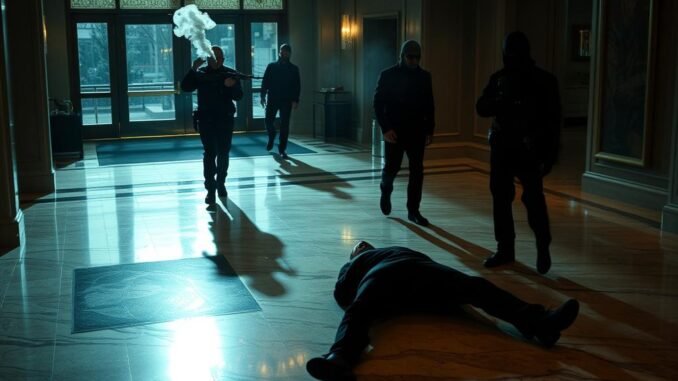

In Quebec, one in five murders was linked to organized crime in 2019. This was the case with the Laval Sheraton shooting. On May 4, 2019, around 10 p.m., shots rang out in the Sheraton Laval lobby. Salvatore Scoppa, a Montreal mafia boss, was rushed to the hospital but sadly died.
The event shocked everyone in the hotel and the province. It was a public hit in a place known for quiet weekends.
The Quebec provincial police soon confirmed Scoppa’s identity as a key figure in organized crime. Laval police reported that two suspects ran away. This led to theories about changes in Quebec’s organized crime groups.
Scoppa had survived an attempt on his life in 2017 in Terrebonne. This showed he was a target for a long time.
This story explains what happened and why it’s important. It shows how the assassination in Laval relates to deeper issues in Montreal’s criminal world. It also explores who was targeted and what it means for Quebec’s organized crime today.
Overview of the Laval Sheraton shooting and its impact on Quebec
Police rushed to the Sheraton Laval lobby around 10 p.m. after shots were fired. Salvatore Scoppa was hit and died at the hospital. This event marked a sad milestone in a year filled with over a dozen mob-related deaths.
The incident caught the attention of the whole province. People from Montreal to Quebec City were talking about it. The event made many feel unsafe, as it happened in a busy hotel area.
The shooting highlighted the growing concern about organized crime in Quebec. It made people think twice about going out at night or traveling. Local businesses near the Laval Sheraton started using more cameras and improving lighting.
Leaders and the Sûreté du Québec quickly spoke out about the shooting. They promised to increase patrols and gather more intelligence. The event put organized crime in Quebec under the spotlight.
| Aspect | Key Details | Why It Matters to Quebec |
|---|---|---|
| Location | Laval Sheraton lobby | High-traffic venue raises public safety concerns in everyday settings |
| Classification | Quebec homicide tied to mob activity | Links the case to organized crime in Quebec and broader trends |
| Community Impact | Heightened anxiety and calls for visible policing | Shows the gangland slayings impact on residents and businesses |
| Law Enforcement Focus | Patrol surges, hotel security coordination, data-sharing | Aims to reassure the public while mapping risk at similar venues |
| Media Attention | Province-wide coverage and daily updates | Keeps pressure on responses to organized crime in Quebec |
Key takeaway: a public venue, a swift police response, and a case that shaped the conversation on safety and the gangland slayings impact across the province.
Timeline of events at the Sheraton Laval hotel
The events at the Sheraton Laval hotel happened quickly, changing the evening and the days that followed. People’s stories, 911 calls, and police reports show a clear timeline. This timeline includes gunfire at hotel lobby reports and the quick work of emergency response Laval teams.
Gunfire reported around 10 p.m. in the lobby area
At about 10 p.m., guests near the reception hall heard loud noises and hid. Staff called 911, focusing on the lobby. The Sheraton Laval timeline mentions a family party nearby, making the scene more crowded and urgent.
Emergency response and transport to hospital
Laval Police arrived fast, followed by firefighters and paramedics. They quickly helped the victim and found the best way to the hospital. The emergency response Laval plan kept the area safe while guiding guests away from danger.
Confirmation of death and immediate police actions
At the hospital, doctors confirmed the victim’s death. On site, police chased two suspects and locked down the main floor. The Sûreté du Québec and Laval Police worked together, following homicide investigation steps. They preserved the lobby, talked to witnesses, and checked CCTV for a detailed timeline.
| Time (approx.) | Key Event | Primary Actors | Evidence Priorities | Operational Focus |
|---|---|---|---|---|
| 10:00 p.m. | Reports of gunfire at hotel lobby near reception hall | Guests, staff | Initial 911 calls, eyewitness positions | Immediate shelter-in-place direction |
| 10:03–10:08 p.m. | First officers arrive; paramedics stage | Laval Police, Urgences-santé | Victim condition notes, scene markings | Rapid triage and corridor control |
| 10:10–10:20 p.m. | Transport to hospital under escort | Paramedics, patrol units | Route timestamps, body-worn camera logs | Clear passage through hotel traffic |
| Shortly after arrival | Death confirmed by medical staff | Hospital team | Clinical confirmation, chain-of-custody notice | Notification to investigators |
| Following confirmation | Perimeter and lockdown of lobby and exits | Laval Police, Sûreté du Québec | CCTV retrieval, ballistic mapping | Handoff to homicide investigation steps |
| Same night | Witness canvass and suspect flight path review | Investigators, forensic team | Surveillance footage, shell casings, trajectory | Reconstruction of escape and timeline integrity |
Victim profile: Salvatore Scoppa’s background and legal history
Salvatore “Sal” Scoppa was known to the Montreal underworld. He was seen as an Italian-Canadian mobster by the media. His life was marked by constant surveillance, danger, and legal battles.
Reports described a figure who navigated influence, rivalry, and fear, while drawing scrutiny from police units tracking the Montreal Mafia.
Known ties to the Montreal Mafia and reputation as an organized crime figure
Stories linked Scoppa to the Montreal Mafia and its associates. He was often called an organized crime figure in court and media. This placed him among the powerful in Quebec’s underworld.
Prior convictions for assault causing bodily harm and breaking and entering
Scoppa had guilty pleas for assault and breaking and entering. These convictions shaped his legal history. They also highlighted his risky reputation.
Surviving a 2017 shooting attempt in Terrebonne, Quebec
In February 2017, a shooting happened in Terrebonne, Quebec. Scoppa was hit but survived. This event raised more concerns about his safety and the dangers he faced.
| Aspect | Details | Relevance to Profile |
|---|---|---|
| Affiliations | Links reported with the Montreal Mafia and a criminal organization | Supports depiction as an organized crime figure |
| Legal record | Guilty pleas: assault causing bodily harm; breaking and entering | Defines legal history and public risk assessment |
| Violence faced | Survived the Terrebonne shooting 2017 at a restaurant | Signals persistent threats and heightened scrutiny |
| Public identity | Portrayed as an Italian-Canadian mobster across multiple reports | Frames perception within Quebec’s underworld |
Links to the Montreal underworld and the Rizzuto crime family
The shooting highlighted ongoing tensions in Montreal’s underworld. It showed the conflict between the Rizzuto crime family and a Calabrian group. Street crews, brokers, and suppliers were all involved, making alliances complex but the stakes clear.
Context of Calabrian versus Sicilian factions in Montreal
Montreal’s underworld is often seen as a battle between Calabrians and Sicilians. The Rizzuto family, with Sicilian roots, gained power through mediation and sharing profits. Calabrian groups wanted their own share and control.
There were stories of pressure, expulsions, and attempts to dominate bookmaking and collections. Each side saw the other’s moves as threats, leading to a cycle of violence.
Drug trafficking investigations and cocaine seizures in related probes
Police were also looking into drug trafficking. They found cocaine worth over 100 kilograms, linked to Andrea “Andrew” Scoppa. The case showed the huge sums of money involved.
Wiretaps and controlled deliveries revealed a battle for the same buyers. This pressure was felt in debt collection and street taxes.
Gangland slayings and patterns of retaliation
The period saw a series of gangland killings. These seemed to be more about sending messages than personal scores. Shootings happened in public places, often after arrests or big seizures.
Retaliation led to more violence, drawing in bikers and independent traffickers. This created a delicate balance where violence could escalate quickly.
| Axis | Key Actors and Links | Typical Flashpoints | Noted Outcomes |
|---|---|---|---|
| Factional Rivalry | Rizzuto crime family (Sicilian roots); Calabrian leadership figures named in affidavits | Control of cafés, bookmakers, collectors | Territory shifts; expulsions; proxy enforcement |
| Narcotics Trade | Port-based brokers; overland couriers; Latin American sources | Drug trafficking routes; wholesale pricing; cocaine seizures | Revenue shocks; informant leverage; court challenges |
| Violence Cycle | Street crews, subcontracted hit teams, allied bikers | Gangland slayings after arrests or large interceptions | Retaliation patterns; instability; fear-driven defections |
| Financial Control | Money launderers, cash businesses, real estate holders | Skim disputes; debt calls; tax on local markets | Asset freezes; sudden closures; capital flight |
Immediate aftermath: suspects, scene management, and early leads
Right after the shots, Laval police said two suspects ran out of the hotel. Officers quickly blocked off the exits and lobby. The hotel area around the ballroom was closed off.
The Sûreté du Québec joined the investigation. Police set up a cordon and watched who came and went. They started talking to hotel staff, guests, and vendors.
Forensic experts collected evidence like bullet casings and traces near the doors. They looked into a planned attack and possible surveillance before the event. They also checked if the shooting was linked to gang disputes.
The police asked for tips and to keep any photos or videos. They kept elevators and service areas under watch. This helped manage the scene and protect the investigation.
As they talked to more witnesses, they matched their stories with video evidence. They were trying to figure out how the suspects escaped. They wondered if the suspects had practiced their escape during busy times.
Salvatore Scoppa

Before the Laval Sheraton shooting, Salvatore Scoppa’s image was shaped by court files and news. He was seen as an Italian-Canadian mobster linked to Montreal’s underworld. His world was one of fast-changing alliances.
Family ties, including brother Andrea “Andrew” Scoppa
Family was key to Salvatore’s story. His brother, Andrea “Andrew” Scoppa, was also in the spotlight. Media called him a Montreal mafia boss with wide influence.
Police linked Andrea to big cocaine cases. This made the brothers’ names known in many neighborhoods.
The brothers’ lives often crossed paths in business and social scenes. This constant overlap made everyone watch their steps around them.
Public perception as an Italian-Canadian mobster and organized crime figure
Salvatore was seen as a mobster in a world of money, loyalty, and fear. News stories painted him as a figure to be watched. People were cautious in his presence.
Reporters followed his connections and rivals. Once a name was linked to him, it followed him everywhere. This included courts, family events, and quiet nights.
Pressure, threats, and the climate around his family before the shooting
Those near the Scoppa family talked about constant threats. Late-night calls and slow cars by their home were common. These small signs hinted at a tense atmosphere.
Friends noticed changes in routines. School runs and restaurant choices became more cautious. The fear of vendettas and rival crews grew, affecting both Laval and Montreal.
| Aspect | Details Reported | Relevance to Risk |
|---|---|---|
| Family ties | Regular associations with Andrea “Andrew” Scoppa; overlapping networks | Raised visibility and drew attention from rivals |
| Public profile | Perceived as an Italian-Canadian mobster and organized crime figure | Increased surveillance by media and adversaries |
| Ongoing climate | Reports of threats and pressure around the home and daily routines | Heightened personal security concerns |
| Montreal context | Speculation involving a Montreal mafia boss and internal rivalries | Amplified risk of sudden confrontations |
The investigation: Sûreté du Québec and Laval Police efforts
Detectives acted fast after the shooting. The Sûreté du Québec led, with Laval Police supporting on the ground. They worked hard to keep a tight timeline and control the scene. They also gave regular updates to keep people informed and protect important clues.
Witness statements, security footage, and forensic collection
Teams talked to hotel guests and staff carefully. They wanted to get new information without anyone sharing too much. They looked at security footage from the lobby and reception to track movements before and after the shooting.
They also collected evidence for lab tests. This included ballistic and trace evidence. It was all part of their detailed forensic collection.
Then, they compared their findings with past cases. They looked for any matches. They also updated timelines and found areas that needed more investigation.
Media coverage highlighting organized crime tensions
Global News and Montreal media highlighted organized crime tensions. Their reports made people more aware of the situation. This put pressure on the authorities to share information carefully.
They wanted to keep the case safe without giving away too much. Analysts looked at past conflicts and recent arrests for clues.
Unresolved motives and competing theories
Despite their efforts, the motives behind the shooting were unclear. They explored different reasons, like factional fights or power struggles. They also checked if outsiders were involved by looking at travel and rental records.
The Sûreté du Québec and Laval Police kept working together. They compared tips with criminal intelligence. They were careful not to jump to conclusions about motives or suspects too soon.
Informant testimony and wire evidence challenges
The court record shows a tense mix of informant testimony and fragile wire evidence in Montreal’s mafia world. Claims link past rivalries to new clues, but recording gaps hide key statements.
Protected informant details about the Falduto brothers’ murders
A protected witness spoke at the Gouin courthouse. He said the Falduto brothers were killed on June 30, 2016. The shootings happened in a garage, targeting Vincenzo and Giuseppe Falduto.
The witness linked the murders to a power struggle. He said the hit was part of a larger conflict in the city’s underworld.
Alleged orders from Scoppa targeting rivals within Montreal’s mafia landscape
The witness claimed Salvatore Scoppa wanted to weaken Sicilian groups. This move aimed to sideline rivals and change the mafia’s balance of power.
He said Scoppa’s orders came through trusted people. The Falduto brothers were targeted because of their threat to the Calabrian side.
Claims about a Toronto-based mob hitman and recording gaps
After cooperating with the Sûreté du Québec in 2019, the witness warned of danger for Scoppa. He met an accomplice at a hotel, where he heard about a Toronto hitman involved in the Laval shooting.
Despite live monitoring, recording gaps lost important admissions. This left prosecutors with only echoes of the truth, making it hard to verify other evidence.
| Element | What the witness reported | Evidentiary status | Impact on case |
|---|---|---|---|
| Falduto brothers murders | June 30, 2016 shootings in Saint-Jude garage targeting Vincenzo and Giuseppe | Corroborated by timelines and venue details in court filings | Anchors chronology and motive narrative |
| Alleged Scoppa orders | Direction attributed to Calabrian-side leadership amid factional struggle | Relies on informant testimony and circumstantial links | Shapes theory of intra-mafia rivalry in Montreal |
| Toronto mob hitman | Described as on parole, calm, and efficient in the Laval attack | Reported in wired conversation; not fully captured on the device | Suggests an external shooter network |
| Recording gaps | Key statements heard live by investigators but missing from audio | Technical shortfall weakened verbatim record | Complicates corroboration and trial use |
Family dynamics and community reactions in Laval and Montreal
In the days after the shooting, community reactions in Laval and Montreal changed. People talked about safety in hotels, restaurants, and malls. These are places where families meet and workers spend long hours.
At grocery stores, school drop-offs, and cafés, conversations were filled with grief and public concern. This mix of emotions was everywhere.
Those close to the Scoppa family felt a lot of pressure. There were threats and fears of being watched. This affected his wife and relatives, who moved between Laval and Montreal for work and school.
Friends said it was hard for the family to balance privacy, mourning, and the attention from the organized crime fallout.
At memorial services, people mourned while also thinking about the big picture. Clergy and community workers in Laval and Montreal talked about the risks in public places. Young people asked tough questions about safety.
The mood was serious but also practical. It was about facing the reality of violence near our daily lives.
People also talked about how the violence affected small businesses and schools. Parents made changes to their routines, like checking lobby cameras. These actions showed how the organized crime fallout impacts our daily lives.
In every neighbourhood, the message was clear: protect the places where we meet. Keep communication open between families, neighbours, and leaders. In this way, community reactions were both caring and cautious as Laval and Montreal dealt with the aftermath together.
Public safety response and community confidence
In Laval and Montreal’s north shore, people wanted reassurance. They looked for steps to calm their nerves and make daily life steady. A careful public safety response aimed to show that streets, hotels, and transit hubs are watched and supported.
Calls for increased patrols and focused investigations
Residents asked for more police near busy areas, like Carrefour Laval and main roads. Police leaders said they are investigating organized crime, including money flows and weapon sources. They promised to act quickly and carefully, without harming innocent people.
Statements from local officials stressing resolve
Local leaders sent a strong message: stay calm, report tips, and expect action. Laval’s mayor and the police service showed support for regional partners, like the Sûreté du Québec. They emphasized working together with community groups and small businesses, who feel the impact most.
Balancing outreach to at-risk groups with enforcement
Community leaders pushed for helping at-risk groups while enforcing the law. They supported clinics that offer counselling and job help. Police made sure to balance prevention visits with trust-building efforts, ensuring focused investigations don’t harm community trust.
As these efforts continue, officials aim to match increased patrols with better data sharing and open briefings. This approach keeps the public safety response clear and present, helping to maintain neighbourhood confidence.
Media narratives and shifting public opinion
The Laval Sheraton shooting got a lot of attention quickly. It stayed in the news for weeks. People followed every update as they discussed risk, safety, and the law.
Coverage by Global News, Montreal outlets, and national media
Global News kept track of the case’s key moments. They linked it to organized crime in Quebec. Montreal media, like the Montreal Gazette and La Presse, added local insights.
National media put the story in the context of a year with many mob-related killings. These reports helped people understand the case’s importance and the pace of it.
Debates over crime prevention, transparency, and justice
Reporting led to debates on crime prevention and justice. People wanted to know about evidence handling and witness safety. Editorials talked about preventing crime, like using more police and helping at-risk youth.
Lawyers and former detectives pointed out challenges, like getting witnesses to talk and missing digital evidence. These issues sparked discussions on how to build strong cases.
Influence of high-profile gangland slayings on public discourse
High-profile gangland slayings had a big impact on public talk. Polls and call-in shows showed people were tired and worried but wanted action. Montreal and national media kept the focus on safety without spreading fear.
As the story went on, people thought about balancing civil rights with strict law enforcement. The mix of local and national views kept the conversation informed and steady.
Broader implications for Quebec’s organized crime landscape
Salvatore Scoppa’s death sent shockwaves through Quebec’s crime world. It showed how the Calabrian–Sicilian feud in Montreal affects power struggles and daily actions. Retaliation patterns are driven by old loyalties and recent grudges, affecting areas beyond Laval.
Informants from the mid‑2010s spoke of Calabrian groups pressuring Sicilian crews. This fits with the changing alliances in criminal networks. Cocaine trade and debt chains allow for quick changes in the game.
Police records from big drug busts and cocaine finds show flexible routes and proxy teams. This challenges the Sûreté du Québec and local police. They focus on long-term intelligence and patient watching, not just quick arrests.
A Toronto shooter hint added complexity to Quebec’s crime scene. Ties between cities allow for outsourced violence, making it harder to track. This pushes authorities to work together and share information.
Now, cross-border and cross-province cooperation is key. Analysts track money, phones, and goods moving between cities. The success of enforcement depends on timing: too early and networks adjust; too late and violence could spike.
Conclusion
The 2019 shooting at the Sheraton Laval marked a violent end to a chapter and raised many questions. The Salvatore Scoppa case showed how quickly a public place can become a crime scene. It highlighted the fragility of public safety in Quebec when gang rivalries are involved.
It also made us think about the Montreal mafia boss legacy. This legacy shaped alliances, debts, and scores over the years.
Police from the Sûreté du Québec and Laval Police worked fast. They collected video, forensics, and witness accounts. But, the case of the unresolved homicide remains unsolved.
Informants spoke of earlier contract hits tied to Scoppa. They even suggested a Toronto-based killer was in Laval. But, missing recordings and wire evidence made it hard to find charges. This left families, neighbours, and officers without closure.
The killing also highlighted ongoing organized crime challenges. It led to calls for more targeted enforcement and better intelligence sharing. People wanted more visible outreach in hotels, restaurants, and event venues.
Residents asked for transparency without fearmongering. Police promised to be vigilant without overstepping. The goal was to protect the public and reduce the space for armed rivals.
Today, the Salvatore Scoppa case is a key part of Quebec’s recent history of gangland slayings. It continues to shape how media report on risk, how officials plan patrols, and how communities view public safety. Until answers come, the case is a reminder of the costs of a Montreal mafia boss legacy and the ongoing fight against organized crime.

Be the first to comment